Loan Against Property Eligibility: LTV, Age & Criteria Explained
13 Oct 2026
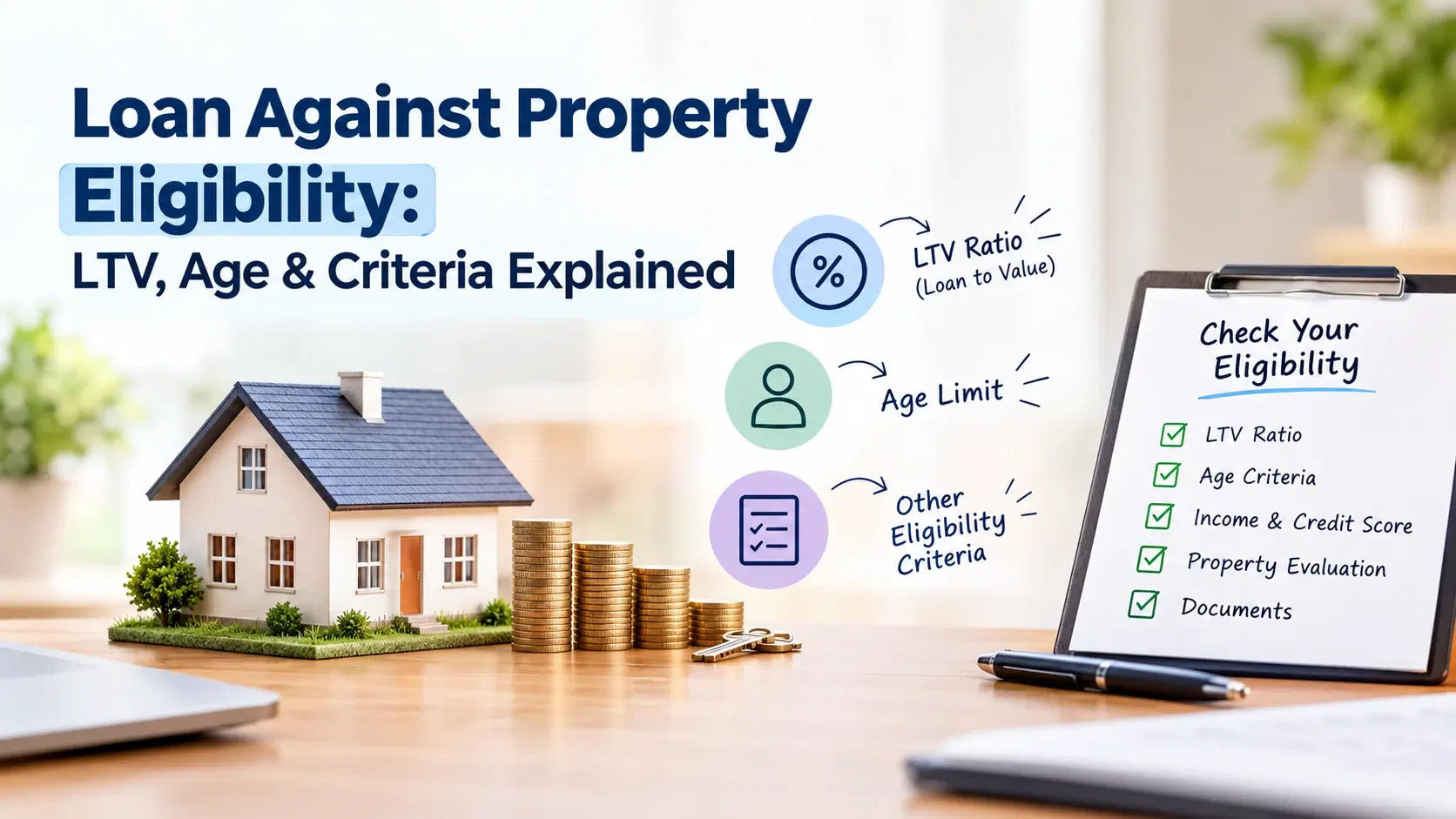
Loan against property (LAP), for any small business or MSME, is a great way to access funds using the property you may already own. But getting your application approved isn't just about finding a lender, but also about meeting their requirements.
Before giving you a loan, banks look closely at your income, business age, current property value, CIBIL score etc. Here is a simple guide to why it matters, and how to know if you qualify.
What is Loan Against Property Eligibility?
LAP involves mortgaging or pledging your property for the funds you require. Therefore, your lender will check your profile, income, property value etc. to ensure that the property is not problematic, and that you can repay the loan you took on the property.
The lender evaluates your property and your profile for the following factors. Based on this, the lender makes a decision. Let's look at them one by one, in detail.
1. Credit Score
Your credit score is the measure of how well you handle your loan repayments. Be it your home loan EMI, business loan EMI or credit card payments, all repayments are considered in credit score calculation. The score always lies between 300 and 900.
A CIBIL score of 675+ is considered to be a minimum eligible score by lenders and NBFCs like Ambit Finvest for considering any application as eligible.
2. Age
Your age is your power. If you are young, your income opportunities are higher and the long-term earning potential is immense. Lenders understand this, and hence, you will see that your DOB or age becomes mandatory information in all applications.
Higher the age, lower the opportunity of increasing income levels. Hence, the upper limit is close to your retirement age. At Ambit Finvest, the age criteria lies between 23 and 65 years of age.
3. Business Vintage
Business vintage helps the lender understand how long your business has been operational. Your balance sheet and financial statements help them further understand how it has been performing revenue-wise. Your business should be operational for 3 years in the same domain. A longer history makes you more credible for the loan you have applied for.
4. Income and Repayment Capacity
The property's value won't determine your eligibility on its own. Lenders also check whether your income or business cash flow can carry the EMIs.
Existing loans, credit card dues, and other fixed costs cut into what you can comfortably borrow. Many lenders look at your EMI-to-income ratio and your overall repayment capacity when they review an application.
5. Property Type
The property has to meet the lender's requirements.
Residential vs commercial property can make a difference, because lenders may assess the two differently. Location, how the property is used, its condition, and how easily it can be sold all affect the valuation, along with its current market value.
6. Ownership and Title
Ideally, the property has a clear ownership trail and proper documents.
A clear, marketable title matters because the lender has to be sure the property can legally be taken as collateral, with no unresolved ownership issues that could put their security at risk.
How Much Loan Can I Actually Get Against My Property?
The maximum loan amount that you can qualify for is decided based on your property's value. It is called LTV or loan-to-value ratio. It tells you what share of your property's assessed value the lender will fund. Most lenders land somewhere between 50% and 75% of the assessed market value. The number shifts with the lender, the kind of property, their LTV policy and how your profile stacks up.
In business loan LTV calculation, the lender does not consider market value. They hire an independent technical evaluator to find the emergency cash-out value of the property. This value is called the Forced Sale Value. Based on this, the LTV is calculated. Now, check the example.
If the lender decides to keep the LTV at 65% and values your property at ₹1 Cr., the loan amount that you will be eligible for is:
Loan Eligibility = Lender evaluated property value × Set LTV
= 1,00,00,000 × 65%
= ₹65,00,000
Your eligible amount now becomes ₹65 Lakhs. Meaning, you can get a loan against property of ₹65 Lakhs.
How Does a Loan Against Property Eligibility Calculator Work?
If you are looking for a Loan Against Property (LAP) for growing your small business, you may want to also check your eligibility. A loan against property eligibility calculator gives you an initial estimate of how much you might be able to borrow against an eligible property.
The eligibility calculator factors in:
- Business Vintage: Number of years you have been running the business
- Annual turnover: Total income of the business before deducting expenses
- Existing loan obligations: If you have any other repayments going on while applying for the LAP
- Property type: Whether you will use residential, commercial or industrial property as collateral
- Property Value: This is the estimated value of your property
So if your property is worth ₹1 crore, an LTV-based calculation might point to a loan range of ₹50 lakh to ₹75 lakh. Your actual eligibility could be lower if your repayment capacity or other financial criteria don't support that amount.
Think of the calculator as a planning tool, not a sanction letter. The lender will still carry out its own credit, legal, technical, and valuation checks before anything is finalised.
For a business owner, checking your loan against property eligibility before applying can help you work out whether the amount you need is realistic and whether you may need a co-applicant or additional documentation.
Who is Eligible for a Loan Against Property?
For Ambit Finvest's loan against property, the stated eligibility criteria are a CIBIL score of 675 or above, age between 23 and 65, at least 3 years of business vintage, and a property with a clear, marketable title.
The product is built for business owners who can offer suitable property as security and show they're able to repay the loan.
Depending on the product and structure, eligible business entities can include:
- Proprietorships
- Partnerships
- LLPs
- Companies
- Trusts
Across the wider lending market, property loan eligibility norms vary quite a bit. Some lenders prefer a credit score of 700 or higher, while others set the bar differently depending on the borrower, the property, and the specific loan product.
Beyond credit score, lenders typically also weigh income, banking history, existing liabilities, property ownership, valuation, title, and documentation.
Meeting the stated criteria does not guarantee approval. The final loan amount and approval decision remain subject to the lender's assessment.
Want the number for your own property? Run it through Ambit Finvest's loan against property eligibility calculator for an indicative property loan eligibility range in a few minutes.
What Property Loan Eligibility Do Self-employed Owners Need?
For business owners, self-employed eligibility can involve a broader assessment than simply checking a monthly salary. This matters a lot for traders, manufacturers, shop owners, and other business owners across Tier 2 and Tier 3 India, where income tends to be seasonal, variable, or simply structured differently from a salaried job.
Usually, lenders demand a minimum business vintage of 3 years.
Lenders may look at things like:
- Business vintage
- Banking conduct
- Business cash flow
- Existing financial obligations
- Credit history
- Property value
- Property documentation
- Available income records
Can a self-employed person without ITR get a loan against property?
Maybe. It depends on the product and how your finances look overall, but thin ITR filings alone won't automatically get you rejected.
That doesn't mean the lender skips checking your income altogether. They may look at other available financial records to understand how your business operates and whether you have sufficient cash flow to repay the loan.
A stable income always signals a positive profile. It gives the lender confidence that you will repay the loan in time, as the income is not uncertain.
Lenders demand collateral as a safety net. You may face uncertainty where repaying the loan or capacity to repay the loan may become zero. Lenders are in the business of making money on interest, not seizing your collateral and selling it for recovering money.
The practical step here is to ask your lender upfront what documents they will accept in place of ITRs. Finding this out before you apply can help avoid delays later in the process.
How Is Loan Against Property Valuation Done?
Two checks happen here, and both matter before any number gets attached to your property: legal verification and technical verification.
Legal verification
This is where the lender digs into:
- Property ownership
- Title chain
- Existing encumbrances
- Approvals and registrations
- Ownership documents
- Legal disputes, if there are any
- Whether the title is clear and marketable
A clear, marketable title isn't just a box to tick. It's the whole basis of the loan, since your property is what's being pledged. If there are ownership gaps or documentation issues, the legal verification may take longer and could affect the lender's decision.
Technical verification
This one's usually a site visit, plus a look at:
- Construction quality
- Property condition
- Location
- Accessibility
- Built-up area
- Usage
- Marketability
The lender's valuation can come in lower than what a broker told you, or what you saw on a listing site. It's more common than you'd think.
For example, even if similar properties in your area are listed at around ₹1.2 crore, the lender may arrive at a different figure after considering the property's location, condition, and construction quality.
And whatever LTV applies gets calculated against that assessed number, not the price you had stuck in your head.
Not sure your documents are strong enough yet? The guide to business loan eligibility for shopkeepers breaks down what a lender checks, step by step.
How Can I Increase My Property Loan Eligibility?
The loan against property eligibility really comes down to two things: how strong your financial profile looks, and how clean the paperwork is on the property you're putting up.
Bring in an earning co-applicant
An eligible co-applicant with their own income can strengthen your case, depending on how the lender weighs it. Worth considering if your income alone doesn't quite cover the loan you're after.
Reduce your existing EMIs
Every loan you're already repaying takes a bite out of what's available for a new one. Clearing off some debt, or consolidating it, before you apply can genuinely move the needle on your repayment-capacity numbers.
Keep your banking clean for 6 to 12 months
If you're self-employed, your bank statement is basically doing the job your salary slip would do for a salaried employee. Six to twelve months of steady, regular banking activity can give the lender a clearer picture of your business cash flow and financial behaviour.
Go with the property that has the cleanest title, not the highest price tag
It's tempting to offer up your most valuable asset, but that's not always the easiest one to get through underwriting. A property with straightforward ownership and complete paperwork moves through legal and technical checks a lot faster than one that's worth more but comes with messy documentation.
Pull your CIBIL report before the lender does
Check it yourself first. Look for overdue entries that shouldn't be there, duplicate accounts, anything that looks off. If you spot something incorrect, get it corrected before submitting your application rather than waiting until the loan is already under review. Don't worry, pulling a CIBIL report for yourself does not reduce your CIBIL score.
For what it's worth, Ambit's own benchmark here is CIBIL 675+.
What Documents Prove Property Loan Eligibility?
The documents required depend on the applicant and lender, but you should generally be prepared with documents relating to both your financial profile and the property.
These may include:
- Identity and address proof
- Income or business-related documents
- Bank statements
- Existing loan details
- Property ownership and title documents
- Other legal or technical property documents requested by the lender
Keeping the documentation ready can make the application process more efficient.
For the full list, read documents required for a loan against property.
What Should You Check Before Applying for a LAP?
Before submitting an application, check four things:
- How much can you comfortably repay? Do not base the borrowing decision only on the maximum amount available against your property.
- What is the property's eligible value? The lender's valuation and the LTV they apply decide how much they might sanction.
- Are the property documents clear? Any problems with ownership or title can slow your application down or affect the outcome.
- Do you meet the lender's eligibility criteria? Before you apply, check your age, credit score, business vintage, income, and any other requirements.
Understanding all these things helps you go into a LAP application with a borrowing figure you can realistically manage, rather than just chasing the biggest loan you can get.
Ready to Check Your Property Loan Eligibility?
Know where you stand before you apply. Use Ambit Finvest's Loan Against Property eligibility tool to check your potential loan against property eligibility in minutes, based on your business and financial profile.
Check Your Loan Against Property Eligibility - If the numbers work for you, go ahead and apply.
Loan Against Property Eligibility and loan terms are subject to applicable criteria, documentation, property valuation, and lender assessment.
Frequently Asked Questions
1. What is the minimum CIBIL score for a loan against property?
Ambit's stated benchmark is 675+, though this isn't a fixed rule across the industry. Different lenders and products set their own thresholds, so it's worth checking what applies to the specific loan you're eyeing.
2. Can I apply against a jointly owned property?
Yes, that's usually workable, subject to the lender's policy. Co-owners typically need to be named in the loan paperwork, and more often than not, they'll need to come on as co-applicants too.
3. Does a commercial property fall under loan against property eligibility?
Yes. It still has to clear the lender's property policy, valuation, title checks, and legal and technical verification. The applicable LTV may also differ from what is offered on a residential property.
4. Does rental income from the property count toward eligibility?
It can, as part of how repayment capacity gets assessed, depending on the lender and what you're able to show. Lease agreements, rent receipts, proof of rental credits landing in your account.
5. What is the maximum tenure?
Up to 15 years, per Ambit's stated product criteria, subject to eligibility and applicable terms.
6. Do I need income proof if the property value is high?
Yes, and people are often surprised by this. A pricey property doesn't automatically prove you can repay a loan against it. Lenders still need to look at your income, business cash flow, and existing obligations to assess whether you can comfortably service the loan.
Important: LTV ranges and eligibility criteria can vary by lender, product, and borrower profile. Ambit-specific figures stated in this article are subject to applicable product terms, documentation, property valuation, underwriting, and final assessment. Meeting eligibility criteria does not guarantee approval.
| Recent Posts |
|---|
Loan Against Property Eligibility: LTV, Age & Criteria |
Documents Required for a Loan Against Property |
Union Budget 2025: Key Reforms and Opportunities for MSMEs |
Used Car Loans: Meaning, Eligibility Criteria |
Unsecured Business Loan - All You Need To Know |
Business Loan Eligibility and Required Documents |
Top 5 Reasons to Get a Business Loan in India |
Collateral-Free Loans in India: How to Apply |
Types Business loan in india |
Unsecured Finance: Types, Definition, and How It Works |
How to choose the right business loan in india |
How to improve credit score importance ranges tips |
Business loan interest rates flat vs reducing |
| Secured Business Loan |
|---|
Loan Against Property Eligibility and LTV |
Documents Required for Loan Against Property |
Secured Business Loan in India |
Types of Secured Business Loan |
How to apply for Secured Business loan |
Eligibility Criteria for Secured Business Loan |
Document Required for Secured Business loan |
| Unsecured Business Loan |
|---|
Unsecured Business Loan - All You Need To Know |
Collateral-Free Loans in India |
Unsecured Business Loan in India |
Types of Unsecured Business Loan |
How to apply for Unsecured Business loan |
Eligibility Criteria for Unsecured Business Loan |
Document Required for Unecured Business loan |
Stay up-to-date with our
Newsletter