Understanding Your Business Loan Eligibility: A Simple Guide for Shopkeepers
January 15, 2025
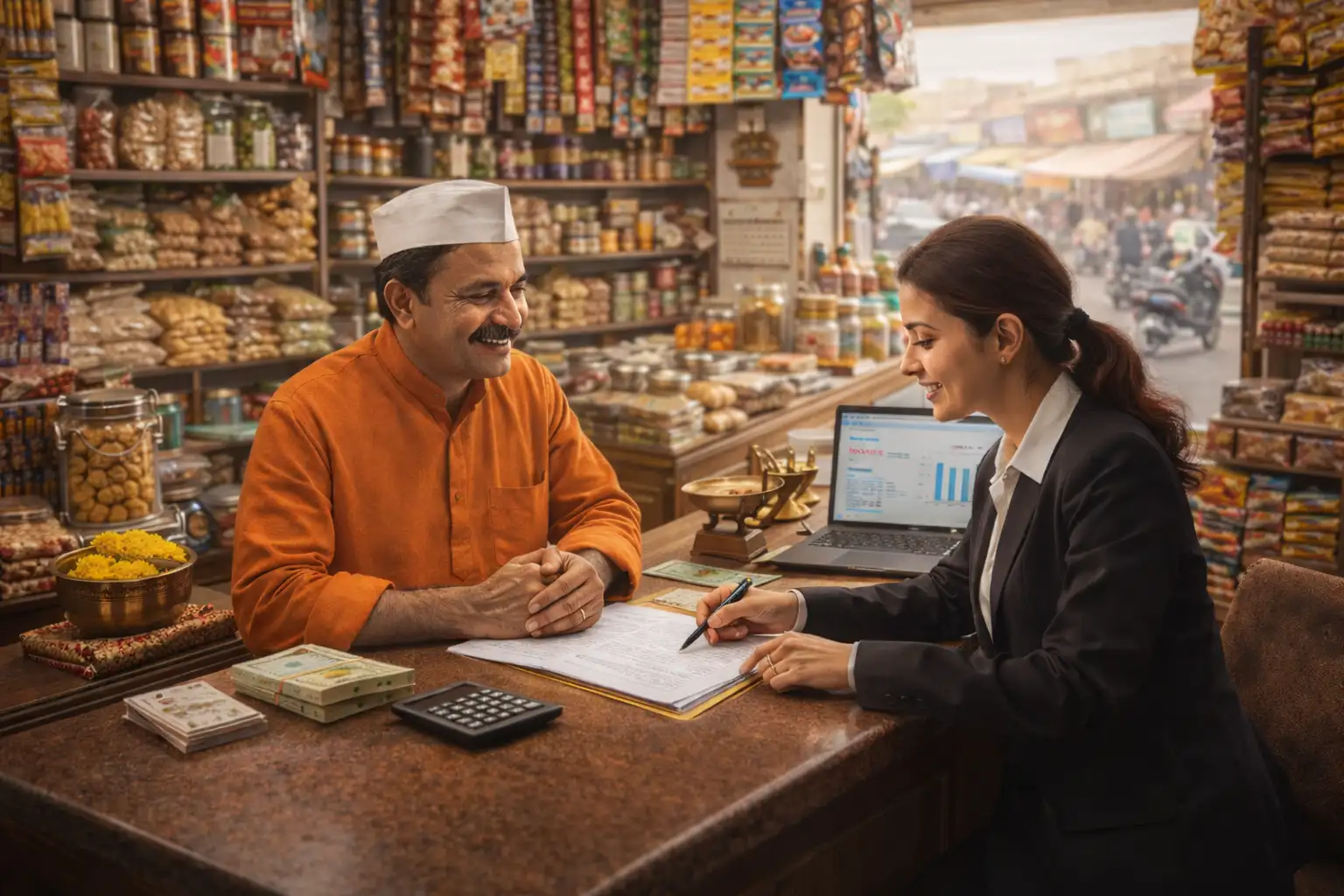
Are you someone looking to grow/expand your business, restock for the festive demand, or hire support staff to handle the festive rush? Business loans can help you do that. The real question stands, whether you will be eligible for a business loan or not?
The business loan application process can be confusing and lengthy. Most shopkeepers and MSME owners are worried that they will spend more time completing the paperwork and loan process, less time growing their business. The stress of the loan not getting approved is again another bigger issue. Sometimes, shopkeepers are unaware of what the lenders are looking for.
We have put together a simple guide to help you understand what loan eligibility is, how to check it, the documents required and various other factors that qualify you for a business loan. Let's get you up to speed.
Key Takeaways
- Loan eligibility is a lender's way of ensuring that the application is a low-risk profile.
- Business loans can help with business expansion, bulk restocking, and resolving cash flow issues.
- Business documentation helps prove the legal and physical presence of your business.
- Financial statements enable lenders to assess your financial stability, cash flow, and other key factors.
What is loan eligibility?
Loan eligibility is simply the lender's calculation of whether you are a "safe" person to lend money to. They want to ensure you can comfortably repay the loan on time.
The eligibility checks are carried out based on various factors including CIBIL score, documents, business age, which we will discuss in detail, in the upcoming sections.
Based on these factors, lenders find out how much EMI you can afford, based on your current financial health and business history.
How do business loans benefit shopkeepers?
Business loans can be a significant advantage to shopkeepers during the festive season. With the introduction of new GST 2.0 reforms, shopkeepers can expect to see more consumers walking in. Our blog on GST 2.0 reforms can help you understand the rate changes and their importance.
Let's understand how shopkeepers can benefit from business loans:
- Business expansion: It helps grow your shop, and add a new section for different products, or even renovate for a more modern look.
- Bulk restocking: It enables purchasing inventory in bulk, especially before festivals, to meet customer demand and secure better prices from suppliers.
- Improve cash flow: A loan can help you manage your daily expenses (like rent, salaries, electricity bills) without stress, especially during slower business periods.
- Upgrade equipment & technology: Invest in a new refrigerator, better shelving, or a modern computerised billing system to improve your efficiency and customer service.
- Build a good credit history: When you take a business loan and repay it on time, you build a positive credit history for your business. This makes it easier to secure larger loans on more favourable terms in the future.
5 Main Factors That Decide Your Eligibility
Business loan eligibility is decided based on various factors and documents. Since the lending company will offer you financial assistance, they will assess your qualifications, and then the loan will be disbursed.
Now, let's discuss the eligibility criteria and reasons why lenders base their decisions on these.
Business Stability & Age
The first factor that lenders will consider is the business's stability and age. Lenders prefer shops/companies that are operational for at least 2-3 years.
Businesses that have been operating in the market for more than 2-3 years have proven that their idea works, and they have customers coming in. These businesses have also managed their day-to-day operations and survived the initial challenges.
If you have been operating a shop at the same location for a considerable number of years, it means that you have established trust and built a loyal customer base. Having loyal customers showcases a reliable business model and is a low-risk indicator.
Your Business's Income
Now that your presence has been verified, it is time for the lenders to review your income. In most cases, shopkeepers will have a consistent income, but the belief should align with your bank statements.
Lenders will review your bank statements to identify patterns that indicate consistent income. Lenders will check your average monthly balance and total sales turnover.
A regular income gives lenders an assurance that you can pay your loan EMIs on time. Hence, building more confidence to approve your loan application.
Your Credit History (CIBIL Score)
Credit history is going to make or break your application. When it comes to a loan, eligibility goes through various stages. One of them is checking your loan repayment history.
CIBIL score is the best measure of your loan repayment history. The score ranges from 300 to 900, where 300 is the lowest and 900 is the highest. On this scale, the higher your CIBIL score, the more chances you have of getting eligible for a business loan.
Whether it's a secured business loan or an unsecured business loan, the credit score plays a crucial role.
You should aim for a score of 700 to qualify for a business loan, as this is the minimum requirement set by all lenders.
Your CIBIL score demonstrates your creditworthiness to lenders and significantly impacts your chances of securing a business loan, as well as the interest rates you are offered. A higher score indicates responsible financial habits, while lower scores can lead to rejected loan applications.
You can read about the CIBIL score and know more about it here.
Existing Loans & Debts
Lenders will review your current EMIs to determine if your income can support additional EMIs. If not, the lender will reject your loan. Lenders can find all your loan-related information in your CIBIL report. You should declare all the existing liabilities and EMIs to maintain transparency.
If you declare false information in the business loan application, the lender is undoubtedly going to reject your loan request. If you have too many EMIs, lenders may think another loan can become a burden on you and you won't be able to pay it back.
To ensure that all information is presented accurately, take your time while completing the application.
Business Documents & Registration
Coming to the critical aspect of the business loan application, the documentation. For many shopkeepers, this is a confusing part. However, let us help you understand the required documentation and why it is needed.
KYC of the applicant
The owners' PAN and Aadhar card helps the lender confirm the identity of the applicant. These documents seem like an additional layer of paperwork, but it is more than that.
RBI has mandated financial institutions, including business loan lenders, to collect applicants' KYC documents. This is important to ensure that the applicant is who they claim to be. It also helps in preventing identity theft and financial fraud.
These are government documents that help lenders understand applicants' financial history and dealings.
Business registration documents
These documents, at a fundamental level, provide proof of the business's legal existence. They let the lenders know that the company is a legally recognised entity.
If these documents are clear, your business passes the first level of checks, allowing lenders to understand your business's legal presence, legitimacy, and structure, as well as other inherent risks associated with a potential borrower.
While the first pass checks are passed, these documents delve deeper into the legal structure and liability of the business. Let's understand them in one line:
- Sole Proprietorship: Registration documents showcase that the business and the owner are legally the same entity. This means that the business's liability is concentrated in a single entity, and its personal assets will be at risk in the event of default.
- Partnership firm: A partnership deed outlines the roles and responsibilities of each partner, profit-sharing ratios, and other relevant details. It also clarifies whether the partners have unlimited or limited liability.
- Private company or LLP: The certificate of incorporation and the Memorandum of Association highlight the business as a separate legal entity. This bestows limited liability on the owner, meaning that the personal assets of the owner or shareholder are generally protected from business debts.
Business registration documents help lenders understand the nature of the business, the structure of the industry, the liability information and the legitimacy of the company. To understand the business documents, please check the table below:
| Document Category | Specific Document | Purpose & Importance |
|---|---|---|
| Personal KYC Documents | Proof of Identity: PAN Card (Mandatory), Aadhaar Card, Passport, Voter's ID, Driving License | To verify the personal identity of the shop's owner (proprietor). Required for all legal and financial processes. |
| Proof of Address: Aadhaar Card, Recent Utility Bills (Electricity, Water), Passport, Voter's ID | To verify the residential address of the owner. Necessary for opening bank accounts and registrations. | |
| Business Entity Documents | For a Sole Proprietorship: No formal business registration document. The business is legally tied to the owner. | The business is identified through the owner's identity and the licenses obtained in the business's name. |
| Shop Premises Documents | If you own the shop: Property Deeds, Sale Agreement, or recent Property Tax Receipts. | Establishes the legal ownership of the commercial space where the shop is located. |
| If you have rented the shop: Rent Agreement/Lease Deed and a No Objection Certificate (NOC) from the landlord. | Proves your legal right to conduct business from the rented premises. | |
| Mandatory Licenses & Registrations | Gumasta License (Shop and Establishment Registration) | Mandatory in Mumbai. Issued by the BMC, it legally permits you to operate a commercial establishment and regulates working conditions. |
| GST Registration Certificate | Mandatory if annual turnover exceeds ₹40 lakh for goods. Allows you to legally collect GST and claim input tax credits. | |
| Udyam Registration (formerly MSME Registration) | Highly Recommended. Provides access to government schemes, priority bank lending, and other benefits for small businesses. | |
| Trade License | May be required by the BMC depending on the specific type of goods you sell. It ensures the business complies with public health and safety norms. |
Bank statements
Your bank statements from the last 1-2 years, as of the application date, are crucial for lenders to understand your transactions, dealings, spending, and financial performance.
Based on the transactions, the lenders can understand your income, whether it is consistent every month or has a trend. It also provides a clear understanding of your cash flow. A consistent cash flow indicates that the shopkeeper has a loyal customer base and stable demand.
All these factors provide lenders with a fair understanding of the borrower's risk profile. When the cash flow is good and fund utilisation is as expected, it showcases a stable financial history, making the profile a low-risk one. This translates into more favourable interest rates and repayment terms, helping reduce EMI burden.
GST registration & fillings
GST registration is one of the crucial documents required for business registration and proving the physical presence of the business. While GST registration might not be mandatory, it is good to have a document. If you are filing GST returns, this document helps build credibility in the eyes of lenders.
By analysing a series of monthly or quarterly GST returns, lenders identify growth in turnover, seasonal patterns, and assess overall stability in the revenue stream.
Quick Tips to Improve Your Loan Eligibility
So far, you might have realized the requirements to become eligible for a business loan, the factors and documents considered to check eligibility of a borrower. Now, let us give you some one-liner quick tips to improve your loan eligibility.
- Maintain a healthy bank balance: Avoid letting your business account balance drop to zero.
- Pay EMIs on time: This is the best way to build a strong CIBIL score.
- File your ITR and GST regularly: This creates an official record of your income.
- Prepare a simple plan: Write down exactly how you will use the loan money (e.g., "₹50,000 for new stock, ₹20,000 for marketing"). This shows the lender you are serious.
- Don't apply for too many loans at once: Each application inquiry can slightly lower your credit score.
- Start with a smaller loan: If you're new to business loans, consider taking out a smaller amount first and repaying it on time to establish a good credit history.
Conclusion
Understanding business loan eligibility can be challenging at times, but our comprehensive guide should help you grasp the details of becoming eligible for a business loan. Keep your documents ready, ensure you understand the business loan requirements, and then choose a trusted partner to help you get eligible for a business loan without any hassles.
Frequently Asked Questions (FAQs)
What is a good CIBIL score to get a business loan for my shop?
A good CIBIL score to get a business loan for your shop should be 675 and above. A score above this indicates that you are a reliable borrower, which increases your chances of approval and potentially secures better interest rates.
Can I get a business loan without providing ITR (Income Tax Returns)?
Yes, you can get a business loan without providing ITR, but you will likely face higher interest rates. Providing ITR makes your application much stronger. You should also offer other bank documents, such as the bank statement and GST return. The more, the better.
How much business loan can I get based on my shop's daily sales?
The business loan amount you can get based on your shop's daily sales will depend on the lender and your business's specific financial history. Typically, you can get business loans ranging from ₹5 Lakh to ₹3 crores.
How quickly can my business loan be approved and disbursed?
The approval and disbursement times for business loans vary from lender to lender. Several factors contribute to these differences in timelines. The completeness of your application, creditworthiness, and other factors will determine the time required for business loan approval and disbursement.
Does applying for a business loan affect my CIBIL score?
Yes, applying for a business loan might affect your CIBIL score. When you apply for a business loan, the lender makes a "hard inquiry" on your credit report, which can temporarily lower your score by a few points. Therefore, you should not apply for a business loan with different lenders at the same time.
| Recent Posts |
|---|
Loan Against Property Eligibility: LTV, Age & Criteria |
Documents Required for a Loan Against Property |
Union Budget 2025: Key Reforms and Opportunities for MSMEs |
Used Car Loans: Meaning, Eligibility Criteria |
Unsecured Business Loan - All You Need To Know |
Business Loan Eligibility and Required Documents |
Top 5 Reasons to Get a Business Loan in India |
Collateral-Free Loans in India: How to Apply |
Types Business loan in india |
Unsecured Finance: Types, Definition, and How It Works |
How to choose the right business loan in india |
How to improve credit score importance ranges tips |
Business loan interest rates flat vs reducing |
| Secured Business Loan |
|---|
Loan Against Property Eligibility and LTV |
Documents Required for Loan Against Property |
Secured Business Loan in India |
Types of Secured Business Loan |
How to apply for Secured Business loan |
Eligibility Criteria for Secured Business Loan |
Document Required for Secured Business loan |
| Unsecured Business Loan |
|---|
Unsecured Business Loan - All You Need To Know |
Collateral-Free Loans in India |
Unsecured Business Loan in India |
Types of Unsecured Business Loan |
How to apply for Unsecured Business loan |
Eligibility Criteria for Unsecured Business Loan |
Document Required for Unecured Business loan |
Stay up-to-date with our
Newsletter