Union Budget 2026: SME Champions, Financial Stability, and Infrastructure Upgrade
02 March 2026
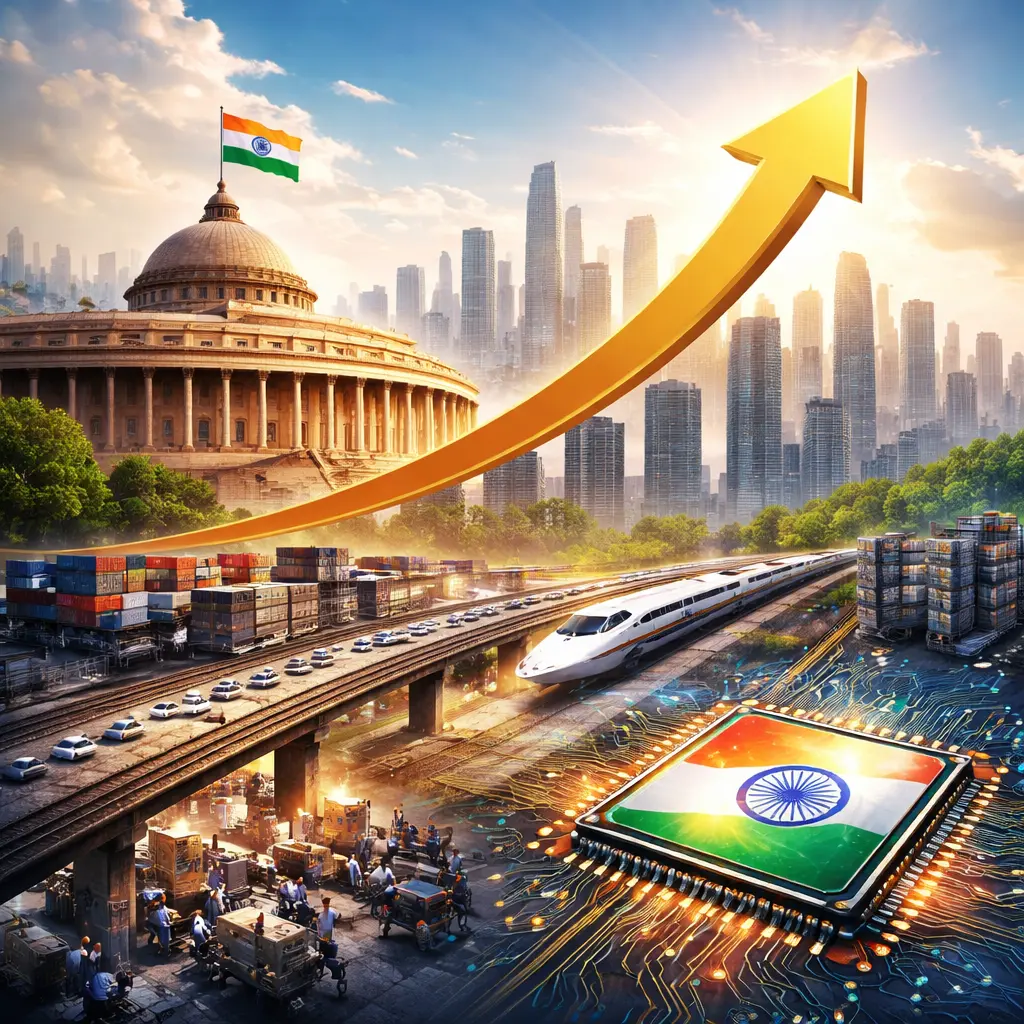
Union Budget 2026 was announced on 1st February, 2026. There was a strong emphasis on sustainable economic growth, infrastructure development, MSMEs, and ease of compliance, alongside emerging sectors like Artificial Intelligence (AI), semiconductor measures, etc.
With a total overlay of ₹53 Lakh crores in 2027, 7.7% higher than the revised estimate for 2025-2026, the government has proposed numerous plans for development, infrastructure, and MSME growth.
Key Takeaways
- Three Kartavyas: Centred on the "Three Kartavyas"—a framework for productivity, aspiration, and inclusive growth.
- Capex Push: Total outlay increased to ₹53 Lakh Crore, with a 9% jump in Capex (₹12.2 Lakh Crore) to fuel infrastructure.
- ISM 2.0: Launch of ISM 2.0 focusing on the "full-stack" (raw materials and design) rather than just assembly.
- MSME Support: New ₹10,000 Crore SME Growth Fund and mandatory TReDS usage to solve the chronic liquidity/payment crisis.
- Creative Economy: A bold move into the creative sector with 15,000 AVGC labs to turn gaming and animation into a mainstream career path.
- Fiscal Stability: A target to reduce the fiscal deficit to 4.3%, signalling long-term economic stability.
The Three "Kartavyas" Framework Guiding Budget 2026
The Union Budget focuses on three Kartavyas (moral obligations of the Indian Government to its citizens). This framework is an execution-driven development approach.
First Kartavya: Accelerate and sustain economic growth by enhancing productivity and competitiveness.
Second Kartavya: Fulfil people’s aspirations, build capacity and make them strong partners in India’s path to prosperity
Third Kartavya: Inclusive growth and development by providing access to resources, amenities and growth opportunities to everyone (Sabka Saath, Sabka Vikaas).
Under the "Three Kartavya" framework, the finance minister has announced the whole budget. In this article, we will focus on the key pillars we identified as the budget's bigger, more constructive highlights.
MSME Support Measures and Reforms in Union Budget 2026
Union Budget 2026 recognizes MSMEs as a vital engine of growth and proposed a three-pronged approach to help them grow as champions.
Equity Support
- The government introduced the SME Growth Fund of ₹10,000 Crore to create future champions and incentivise enterprises based on select criteria.
- A total of ₹2000 Crore top-up to the Self-Reliant Fund to continue supporting micro enterprises and maintaining access to risk capital.
Liquidity Support
Most MSMEs face one common problem: liquidity issues. They may provide a service or fulfill an order, but there is a delay in the payment. Many TReDS reforms have been proposed to improve MSME liquidity. CPSEs have been mandated to use the TReDS platform for payments and to provide credit guarantee support for invoice discounting.
Professional Support
The government will help institutes like ICAI, ICSI, and ICMAI design short-term courses and practical tools to develop a small team of “Corporate Mitra,” especially in Tier 2 and Tier 3 towns. These para-professionals will help MSMEs meet compliance requirements at affordable costs.
With the US tariff rising to 50% and then falling to 18%, the Government laid the groundwork for defensive and structural measures to reduce the impact of the tariffs. The National Fibre Scheme, Special Economic Zone flexibility, Custom duty rationalisation, etc., were among the many reforms outlined to reduce the impact of US tariffs.
Focus on Fiscal Deficit
Our finance minister proposed reducing our fiscal deficit from 4.4% to 4.3%. Now, this might seem like a small drop, but this impacts a lot more than it seems. This lower deficit signals fiscal discipline to global investors, potentially lowering the country's borrowing costs.
Did you know?
Fiscal deficit is the gap between government income and spending. It is as simple as, you earning ₹10,000 and spending ₹15,000. The deficit is ₹5000 which you will have to cover through some form of debt or borrowing.
Infrastructure & Connectivity
The government has increased the capital expenditure (Capex) by 9% from ₹11.21 lakh Crore in 2025-2026 to 12.2 Lakh Crore in 2026-2027.
Where will this capital be deployed?
- Expanding the freight corridors and national waterways to reduce the logistics cost and improve market integration
- Seven high-speed rail corridors are proposed to connect major cities, including Hyderabad, Delhi, and Chennai.
- City Economic Regions (CERs) are proposed to strengthen regional development. This is specifically for Tier-2, Tier-3, and temple towns to develop them into self-sustaining hubs.
Professionals for Viksit Bharat
The Union Budget also mentioned about skilled youth and how new career pathways can help build the growth aspects for the youth of the country. The Yuva Shakti-driven budget addressed crucial development priorities for professionals across fields such as health, medical tourism, AVGC content creator labs, sports, and more.
The Orange economy
This is an initiative under the second Kartavya, fulfilling the aspirations of a youthful India. The aim is to promote youth in creative fields like game development, animation, comics, etc., who are interested in building careers but lack structured, scalable skill development in Animation, Visual effects, and Comics (AVGC) content.
The Government has proposed to set up 15000 AVGC content creator labs and 500 colleges for skilled professionals in this area.
Did you know?
India’s AVGC sector is a growing industry. It is projected that almost 2 million AVGC professionals will be hired by 2030. The Budget proposes to support the Indian Institute of Creative Technologies.
Allied Health Professionals (AHPs)
Add up to 1,00,000 AHPs by upgrading the existing institutions and establishing new AHP institutions in the private and Government sectors. This will cover 10 selected disciplines, including optometry, radiology, anaesthesia, Applied Physics, Behavioural Health, and OT Technology.
India Semiconductor Mission (ISM) 2.0
With a total overlay of ₹40,000 Crores in the Electronic Component Scheme, the government aims to focus on four new areas beyond building factories, including controlling the entire value chain.
- Incentivising domestic production of manufacturing tools like lithography, etching and raw materials like silicon wafers, speciality gases, and chemicals.
- A strategic push to build full-stack Indian IP, support at least 50 fabless startups through an enhanced Design Linked Incentive Scheme.
- Focus on building advanced nodes in 3-nanometer and 2-nanometer technologies to enhance chip performance and make them more energy-efficient.
- To build “Rare Earth Corridors” in states like Odisha and Tamil Nadu for securing crucial minerals required for chip production.
- Provisions have been announced to set up training and research centres to create a specialized workforce and bridge the gap between academic knowledge and industrial requirements.
Rejuvenation of Legacy Industrial Clusters
The government has identified up to 200 industrial clusters that currently lack modern machinery and competitiveness. The government will help these industrial clusters revive production, targeting a 25% contribution to GDP by modernising older industrial hubs.
Our Take on the Budget
The Union Budget 2026 emphasised growth, a sustainable economy, fiscal deficit reduction, building sectoral excellence, and MSME competitiveness.
The overall focus on all-round growth for the country, making people part of India’s growth story, and the Government's aim to train individuals in key skills like manufacturing “full-stack Indian IP” to build Rare Earth Corridors are commendable.
The Budget 2026 is not a populist budget. It is the budget that focuses on sustainable economic growth, MSME growth, and positioning India as a nation with all-round competence and global competitiveness.
Frequently Asked Questions (FAQs)
| Recent Posts |
|---|
Union Budget 2026: SME Champions, Financial Stability, and Infrastructure Upgrade |
How to get an MSME business loan without collateral in 2026? |
Union Budget 2025: Key Reforms and Opportunities for MSMEs |
Used Car Loans: Meaning, Eligibility Criteria |
Unsecured Business Loan - All You Need To Know |
Business Loan Eligibility and Required Documents |
Top 5 Reasons to Get a Business Loan in India |
Collateral-Free Loans in India: How to Apply |
| Secured Business Loan |
|---|
Secured Business Loan in India |
Types of Secured Business Loan |
How to apply for Secured Business loan |
Eligibility Criteria for Secured Business Loan |
Document Required for Secured Business loan |
| Unsecured Business Loan |
|---|
Collateral-Free Loans in India |
Unsecured Business Loan in India |
Types of Unsecured Business Loan |
How to apply for Unsecured Business loan |
Eligibility Criteria for Unsecured Business Loan |
Document Required for Unecured Business loan |
Stay up-to-date with our
Newsletter