MSME and Government Loan Schemes in India: A Business Owner's Guide
16 Oct 2026
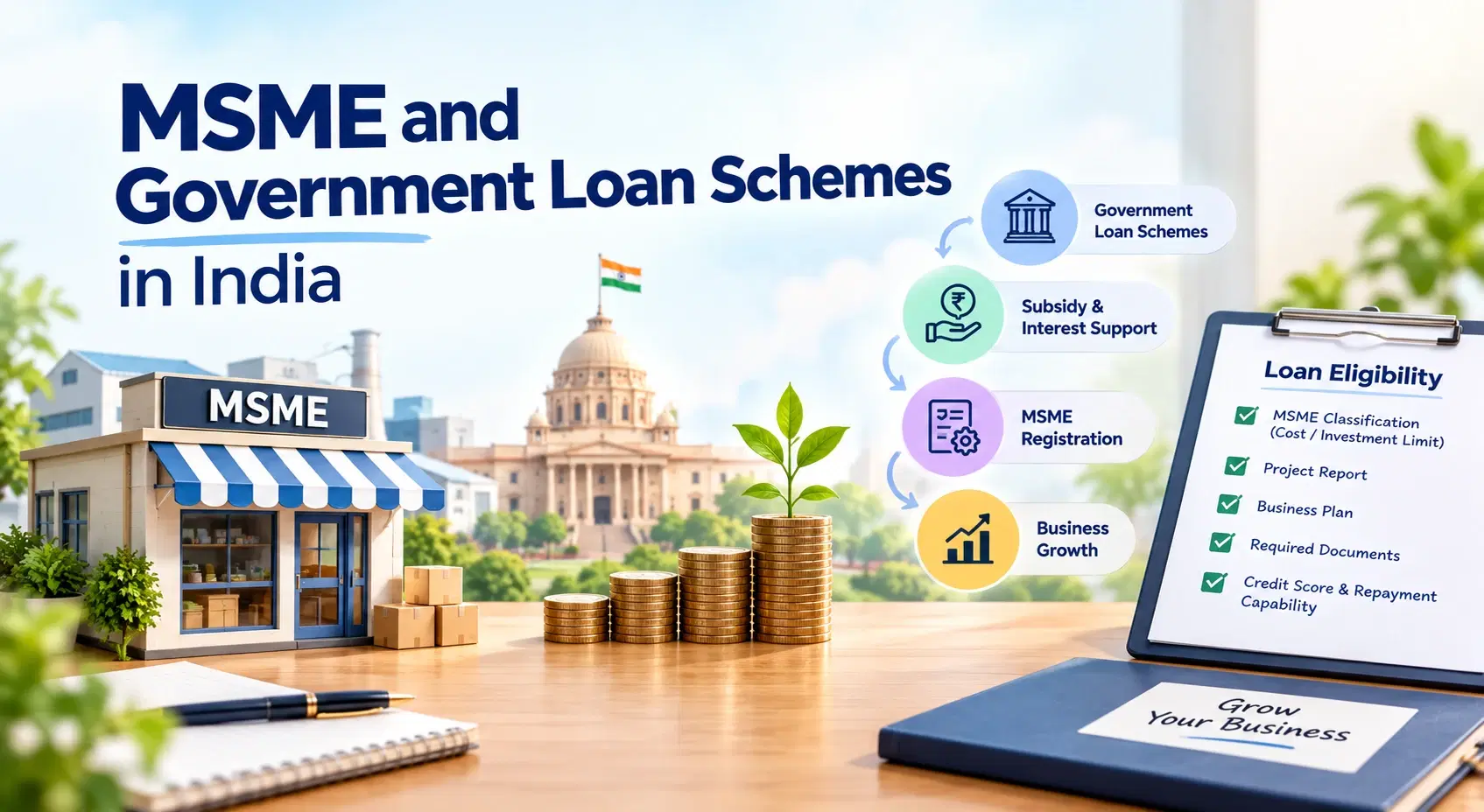
Government business loans can help you start or grow a small business. The government runs several of them for micro and small businesses, and each MSME loan scheme is built for a different type of owner and loan size. This guide has compiled all the MSME loan schemes in one table for you to see which one is right for you. If you hear names like MUDRA, CGTMSE and PMEGP and are not sure where to start, then this page is for you.
Which Government Business Loans and MSME Loan Schemes exist for MSMEs?
MSME loan schemes have six main government business loan options. Different user groups, loan sizes, and benefits for each. This is a short representation of what the schemes are provided in the tabular format below. We will discuss the same in detail in the upcoming sections.
| Scheme | Who it is for | Amount range | Standout benefit |
|---|---|---|---|
| MUDRA (PMMY) | Small non-farm businesses, first-time borrowers | Shishu: Up to ₹50,000 Kishor: ₹50,001 to ₹5 lakh Tarun: ₹5 lakh to ₹10 lakh Tarun Plus: ₹10 lakh to ₹20 lakh | Collateral-free by design |
| CGTMSE | Micro and small units that have no property to pledge | Up to ₹10 crore | 75% to 85% government-backed credit guarantee |
| PMEGP | New manufacturing or service units | Project cost up to ₹50 lakh (manufacturing) and ₹20 lakh (services) | Margin-money subsidy of 15% to 35% |
| Stand-Up India | SC/ST and women entrepreneurs starting a new business | ₹10 lakh to ₹1 crore | Composite loan for term and working capital |
| PM Vishwakarma | Traditional artisans and tradespeople | ₹1 lakh first tranche, ₹2 lakh second tranche | Collateral-free, with toolkit and training support |
| PSB Loans in 59 Minutes | Established MSMEs that want a fast decision | Up to ₹5 crore | In-principle approval in 59 minutes |
Not sure where your business stands? Get your Udyam Registration first. It can help you identify your MSME category and check which schemes you may be eligible for.
What is a MUDRA loan (PMMY)?
The Pradhan Mantri MUDRA Yojana (MUDRA loan) is applicable to small non-corporate and non-farm businesses. You can use a MUDRA loan for trading, manufacturing, food processing, transport and services.
| Tier | Loan amount | Best for |
|---|---|---|
| Shishu | Up to ₹50,000 | Very small or new businesses |
| Kishor | ₹50,001 to ₹5 lakh | Growing businesses |
| Tarun | ₹5 lakh to ₹10 lakh | Established businesses |
| Tarun Plus | ₹10 lakh up to ₹20 lakh | For borrowers who successfully repaid a Tarun loan |
MUDRA loans are provided through banks, microfinance institutions and other approved lenders. Interest, repayment and security conditions depend on the lender. MUDRA could work for a small shop, food business, repair service or transport operator seeking funds for stock, tools or equipment.
What is CGTMSE and how does it give collateral-free credit up to ₹10 crore?
CGTMSE (Credit Guarantee Fund Trust for Micro and Small Enterprises) does not lend money to you. It gives a guarantee to your bank or NBFC. Because of this guarantee, a lender can give you a loan without asking for property as security.
The current collateral-free limit is ₹10 crore per eligible borrower. Check the CGTMSE website for the latest information. You still have to repay the loan, and the lender still checks your business before approving it.
What is PMEGP, the MSME loan scheme for new business?
The Prime Minister's Employment Generation Programme (PMEGP) is often considered the go-to MSME loan scheme for new business. It is aimed at eligible first-time micro-enterprise projects in manufacturing, services industry, etc. It gives a margin-money subsidy to people who set up a new manufacturing or service unit. The subsidy is usually between 15% and 35%. It depends on your category and where your unit is located.
The Khadi and Village Industries Commission (KVIC) runs the scheme. The maximum project cost is usually ₹50 lakh for manufacturing and ₹20 lakh for services. You put in a part of the cost, and the bank gives the rest as a term loan and working capital.
The subsidy is not paid as cash on day one. It is linked to your loan account and has a lock-in period. Prepare a clear project report that covers machinery, rent, staff, raw material, sales and expected profit.
What is Stand-Up India?
Stand Up India supports greenfield businesses i.e., a new enterprise set up for the first time by eligible women entrepreneurs and Scheduled Caste or Scheduled Tribe entrepreneurs. The enterprise can be in manufacturing, services, trading or some allied activities.
The scheme generally offers a composite bank loan combining term loan and working capital, ranging from ₹10 lakh to ₹1 crore. The borrower must make the required contribution and satisfy ownership and management requirements. In the case of a non-individual business, the eligible woman or SC/ST entrepreneur must have the requisite shareholding and control.
This can be a good option for a proposed business that requires more funds than a small MUDRA loan. A clear project report and a feasible repayment plan can strengthen the application.
What is PM Vishwakarma?
PM Vishwakarma is for eligible artisans and craftspersons working with their hands and traditional tools in one of the notified trades. These include carpenters, blacksmiths, potters, cobblers, masons, goldsmiths, tailors, barbers and many more trades.
PM Vishwakarma supports traditional artisans and tradespeople by providing a collateral-free first loan of up to ₹1 lakh, repayable over 18 months. Borrowers who repay well and meet scheme conditions can get a second loan of up to ₹2 lakh. The scheme also gives skill training and a toolkit incentive. Only notified trades qualify, so check the official list first.
What are PSB Loans in 59 Minutes?
PSB Loans in 59 Minutes is an online platform that sends your loan request to public sector banks. You can apply for loans up to ₹5 crore. The platform looks at your tax filings, bank data and credit records.
Many people think the money arrives in 59 minutes. It does not. The 59 minutes is for the in-principle decision only. The bank may still ask for documents and do its own checks before it pays out. If your GST returns, tax filings and bank statements do not match, you may face delays.
How do I pick the right MSME loan scheme?
Use this quick guide:
- First loan under ₹10 lakh? Choose MUDRA.
- Starting a new unit and want a subsidy? Choose PMEGP.
- SC/ST or woman owner starting fresh? Choose Stand-Up India.
- Traditional artisan or tradesperson? Choose PM Vishwakarma.
- Established unit that needs lakhs to crores, with no collateral? Choose CGTMSE-backed credit.
- Want a fast decision from a public sector bank? Try PSB Loans in 59 Minutes.
Before you sign, compare the processing fee, repayment period, your own contribution, and the rules on subsidy. A subsidy lowers your cost, but you still have to repay the loan.
Looking for a business loan without collateral? Explore your options with our guide to MSME loans, covering Mudra, CGTMSE and NBFC loans in one place.
What if no MSME loan scheme fits my business?
Sometimes no scheme is the right fit. Scheme limits can be small for an established business. Some owners do not meet the category rules. Government processes can also take time.
If you own property, a secured business loan can be another option. You can raise a larger amount over a longer period. Our secured business loan is secured against property, so it suits established owners with a bigger need.
Conclusion
An entrepreneur can use government business loans to start, modernise or expand an MSME. MUDRA caters to smaller needs, PMEGP offers a combination of bank finance and potential subsidy for eligible new schemes, CGTMSE can assist with credit without collateral, and schemes like Stand Up India and PM Vishwakarma are aimed at specific groups. PSB Loans in 59 Minutes makes the initial application process more digital, and priority sector lending improves formal recognition of MSME credit.
The best option will depend on your business stage, funding need, eligibility and ability to repay. Compare offers and check official conditions before signing a loan agreement. For practical insights on business finance and financial planning, visit Ambit Finvest.
Frequently Asked Questions
Is Udyam registration mandatory for these schemes?
Yes. Udyam registration proves your MSME status, and lenders usually ask for it. Banks can also count eligible MSME loans under priority sector lending when your Udyam registration shows your MSME status. This does not make approval automatic. Learn more in our guide to Udyam registration benefits.
Are government scheme loans interest-free?
No. Lenders charge interest as per their own terms. Some schemes give a subsidy or interest support, but the loan is not free.
Can an existing business get a MUDRA loan?
Yes, in many cases. MUDRA is open to existing small non-farm businesses, depending on the lender and your records. PMEGP, on the other hand, is mainly for new units.
Can I combine two schemes?
Each scheme has its own rules. For example, PMEGP is meant for new units that have not taken another government subsidy. Ask your bank before you apply for more than one.
Do these schemes need collateral?
It depends on the scheme. MUDRA and PM Vishwakarma are collateral-free. CGTMSE works through a guarantee: the government-backed trust guarantees your lender, so the lender can lend without asking for property.
| Recent Posts |
|---|
Section 44AD Presumptive Taxation: Tax Rules & Filing |
MSME and Government Loan Schemes in India: A Business Owner's Guide |
Loan Against Property Eligibility: LTV, Age & Criteria |
Documents Required for a Loan Against Property |
Union Budget 2025: Key Reforms and Opportunities for MSMEs |
Used Car Loans: Meaning, Eligibility Criteria |
Unsecured Business Loan - All You Need To Know |
Business Loan Eligibility and Required Documents |
Top 5 Reasons to Get a Business Loan in India |
Collateral-Free Loans in India: How to Apply |
Types Business loan in india |
Unsecured Finance: Types, Definition, and How It Works |
How to choose the right business loan in india |
How to improve credit score importance ranges tips |
Business loan interest rates flat vs reducing |
| Secured Business Loan |
|---|
Loan Against Property Eligibility and LTV |
Documents Required for Loan Against Property |
Secured Business Loan in India |
Types of Secured Business Loan |
How to apply for Secured Business loan |
Eligibility Criteria for Secured Business Loan |
Document Required for Secured Business loan |
| Unsecured Business Loan |
|---|
Unsecured Business Loan - All You Need To Know |
Collateral-Free Loans in India |
Unsecured Business Loan in India |
Types of Unsecured Business Loan |
How to apply for Unsecured Business loan |
Eligibility Criteria for Unsecured Business Loan |
Document Required for Unecured Business loan |
Stay up-to-date with our
Newsletter