How to Improve Your CIBIL Score to Get a Business Loan
22 Oct 2026
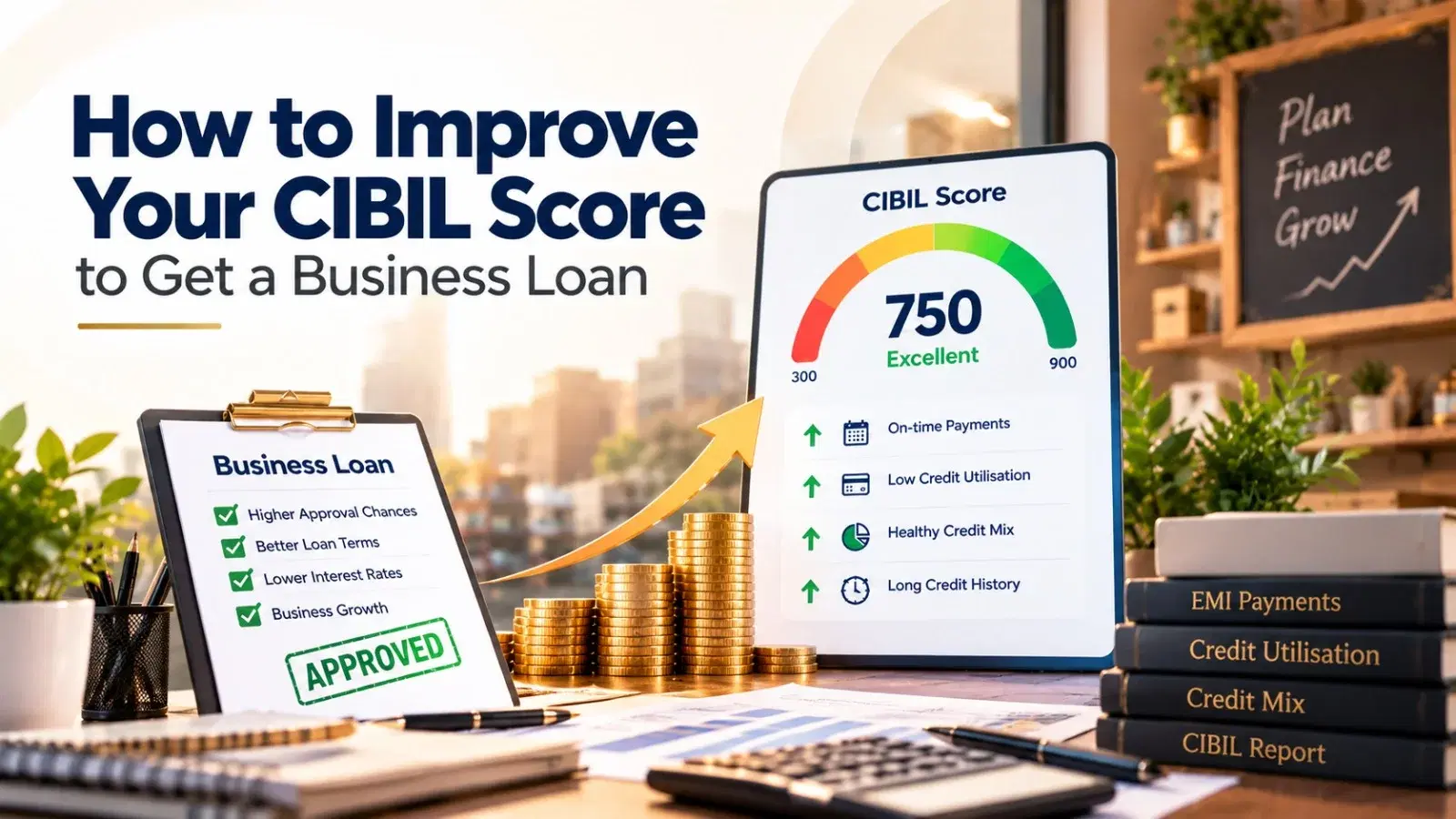
Your CIBIL score is a snapshot of your financial discipline, scored on a scale from 300 to 900. Lenders closely evaluate this score to decide whether to approve your loan application. A score of 675 and above is considered a good score. A poor score can instantly stall your financial plans, making continuous credit management essential. In this guide, we’ll walk you through the exact steps to build and improve your CIBIL score.
What CIBIL score is needed for a business loan?
There’s no single, universal minimum score for business loans. It depends entirely on the lender and the product. Lenders may consider a CIBIL score in the range of 650 to 750, depending on your credit history and overall financial profile.
CIBIL scores run from 300 to 900. Generally, the higher the number, the stronger your credit history looks.
| CIBIL score | General interpretation | What it may mean for a business borrower |
|---|---|---|
| 300 to 549 | Poor | May reflect significant repayment or credit-management issues |
| 550 to 649 | Fair | Lenders may examine the application more closely |
| 650 to 749 | Good | Indicates a comparatively healthier credit profile |
| 750 to 900 | Very good to excellent | Generally reflects a strong repayment history |
A score of 750 or above usually points to a well-managed credit profile, but it’s only one piece of how a lender assesses a business loan. They’ll also look at things like business stability, banking conduct, existing liabilities, turnover, repayment capacity, documentation, and security where it applies.
If your score currently falls short of where you need it, the real question becomes how to increase your CIBIL score without taking on credit you don’t actually need.
5 ways to improve your CIBIL score
Improving your CIBIL score may sound difficult, but with the right setup and correct steps, you can achieve this objective. We have put together 5 ways to help you improve your CIBIL score. Take a look:
1. Timely EMI repayments
Set up auto-payments or reminders so you don’t have to remember the repayment schedule. The EMI will be deducted from your account on a fixed date. All you have to do is maintain sufficient balance in your account.
2. Bring credit utilisation under 30%
Your credit utilisation helps the lender understand if you are dependent too much on credit. As a practice, you should limit your credit usage to 30% of the available limit. For example, if your limit is ₹3 lakh, you should not utilise more than ₹90,000 in total. It could be a credit card or an overdraft facility you may have opted for.
3. Space out new credit applications
Spacing out your loan requirement can help you a ton in this. If you are applying for a loan, first check your loan eligibility. You may be looking for a ₹10 lakh loan, but your current financial commitments may only allow loans up to ₹4 lakh. Loan eligibility calculators can help you in this case. If you directly apply for a loan, your lender will check your credit score, and it may lead to a drop in your credit score.
4. Keep older credit accounts open when it makes sense
If you have any long-term loans, keep them going even when you could close them early. Since these are long-term credit accounts, you know you can make timely repayments without making them a burden on you.
5. Maintain a healthy credit mix
A responsibly managed blend of secured (loan against property) and unsecured (credit card) loans can strengthen an established profile. Take loans wisely, only when you need them the most. Do not take loans only to make this mix possible. Remember, your credit score can increase by repaying more, however, keep the repayments to only 30% of your total income.
Improving your credit score is not easy if the right steps are not taken. There is no guaranteed way to improve your CIBIL score fast, but these 5 steps can be of immense use on the journey to improve it.
Want to know more about CIBIL scores and ranges? Read Ambit Finvest’s guide to CIBIL score importance and ranges which covers the basics this post assumes you already know.
How to fix errors in a CIBIL report?
If something in your CIBIL report looks off, you can raise it through CIBIL’s dispute process and have it verified. Often, correcting an inaccurate entry is a far better use of your time than taking on new credit to compensate for it.
- Step 1: Check your credit report. Go through it line by line: personal information, active and closed loan accounts, outstanding balances, payment history, account status, and credit enquiries. You can check your CIBIL report free online. There are multiple apps and websites that help you download credit reports for free.
- Step 2: Find the incorrect information. Be specific. A payment may appear late when it was on time, a closed loan may still appear active, the balance may be wrong, there may be a duplicate entry, or an account may belong to someone else.
- Step 3: Raise a dispute. Use CIBIL’s online dispute process to submit the details and flag what needs verification.
- Step 4: Wait for lender verification. CIBIL forwards the entry to the relevant credit institution. The bureau won’t change lender-reported information without this step.
- Step 5: Check the updated report. If the lender confirms the error, the record gets updated, usually around 30 days depending on the dispute and the lender’s response. If the information is accurate, disputing it won’t remove it just because it’s hurting your score.
How long does improvement take?
There’s no fixed timeline here. For most people, improvement comes from months of steady, consistent credit behaviour rather than a quick fix. Some changes, like lower utilisation, tend to show up faster than others, like rebuilding a damaged repayment history.
| Credit action | Indicative timeframe | What it means |
|---|---|---|
| Reducing high credit utilisation | About 1 to 3 months | Lower utilisation may be reflected after subsequent reporting cycles |
| Maintaining timely payments | About 4 to 12 months and beyond | Consistent repayment can gradually strengthen the credit profile |
| Correcting an inaccurate entry | Often around 30 days | Depends on lender verification and the dispute process |
| Recovering from settlement or write-off history | Longer term | Historical adverse information can continue to affect lender assessment |
These are indicative timeframes, not guarantees. Paying EMIs on time is one of the key ways to maintain a healthy CIBIL score. Missed or late EMI payments can lower the score and may take time to recover. Keep loan repayments regular and avoid taking on more debt than the business can comfortably repay. Be cautious of anyone promising a guaranteed increase in your CIBIL score within a fixed time.
While your score rebuilds, the rest of your loan file does not have to wait. The guide to SME business loan eligibility and process covers what else lenders check alongside the score.
Business owners have two credit files
For business owners, personal CIBIL and commercial credit information aren’t always one and the same. A proprietor is often assessed largely on their personal credit profile, while companies and firms also carry a separate commercial CIBIL report and related commercial credit data. Knowing which one applies to you matters when you’re preparing to borrow.
Personal CIBIL score for proprietors: If you’re running a proprietorship, your personal credit history can weigh heavily in how a business loan application is assessed, since your personal borrowing, repayment behaviour, utilisation and enquiries all come into play.
Commercial CIBIL report: This tracks the credit history of the business itself. For an eligible company or firm, lenders may weigh it alongside other business and financial factors. It’s a separate file from your personal CIBIL score.
Does a low score mean no business loan?
Not necessarily. A low score narrows your options and can worsen the terms on offer, but it doesn’t automatically mean rejection. There’s no universal cutoff for business loan approval, since every lender applies its own credit policy and looks at the borrower’s overall profile:
- Business vintage
- Turnover and cash flows
- Banking conduct
- Existing obligations
- Financial statements
- Business stability
- Security offered
- Personal or commercial credit history where applicable
If you’re below that today, it’s worth spending time strengthening your credit profile before applying. A lower score is one factor among many, not the single deciding one, and it’s never a guaranteed approval or rejection either way.
Strengthen your credit profile before applying
Improving your CIBIL score isn’t about finding a quick fix. It’s about showing consistent financial behaviour over time. As a business owner, start with the basics: pay every EMI and card bill on time, keep utilisation in check, avoid unnecessary hard enquiries, and review your credit report regularly. If you spot something wrong, raise a dispute instead of trying to offset it with more borrowing.
While you’re at it, keep the rest of your business loan profile in shape too: steady banking conduct, consistent turnover, and documentation that’s ready to go.
If your CIBIL score is 675 or above, you can check your eligibility for an Ambit Finvest business loan.
You can also learn more about a secured business loan and the factors lenders consider when assessing secured borrowing. For more background on CIBIL score importance and ranges, read our guide on the topic. And if you’re getting your application together, take a look at the documents required for a business loan.
A stronger CIBIL profile takes time, but every on-time repayment and sensible credit decision moves you closer to a healthier financial record.
Frequently Asked Questions
| Recent Posts |
|---|
Business Loans for Women Entrepreneurs in India: Schemes and Options |
How to Improve Your CIBIL Score to Get a Business Loan |
Section 44AD Presumptive Taxation: Tax Rules & Filing |
MSME and Government Loan Schemes in India: A Business Owner's Guide |
Loan Against Property Eligibility: LTV, Age & Criteria |
Documents Required for a Loan Against Property |
Union Budget 2025: Key Reforms and Opportunities for MSMEs |
Used Car Loans: Meaning, Eligibility Criteria |
Unsecured Business Loan - All You Need To Know |
Business Loan Eligibility and Required Documents |
Top 5 Reasons to Get a Business Loan in India |
Collateral-Free Loans in India: How to Apply |
Types Business loan in india |
Unsecured Finance: Types, Definition, and How It Works |
How to choose the right business loan in india |
How to improve credit score importance ranges tips |
Business loan interest rates flat vs reducing |
| Secured Business Loan |
|---|
Loan Against Property Eligibility and LTV |
Documents Required for Loan Against Property |
Secured Business Loan in India |
Types of Secured Business Loan |
How to apply for Secured Business loan |
Eligibility Criteria for Secured Business Loan |
Document Required for Secured Business loan |
| Unsecured Business Loan |
|---|
Unsecured Business Loan - All You Need To Know |
Collateral-Free Loans in India |
Unsecured Business Loan in India |
Types of Unsecured Business Loan |
How to apply for Unsecured Business loan |
Eligibility Criteria for Unsecured Business Loan |
Document Required for Unecured Business loan |