GST Composition Scheme Explained for Small Businesses and Traders
1 October 2026
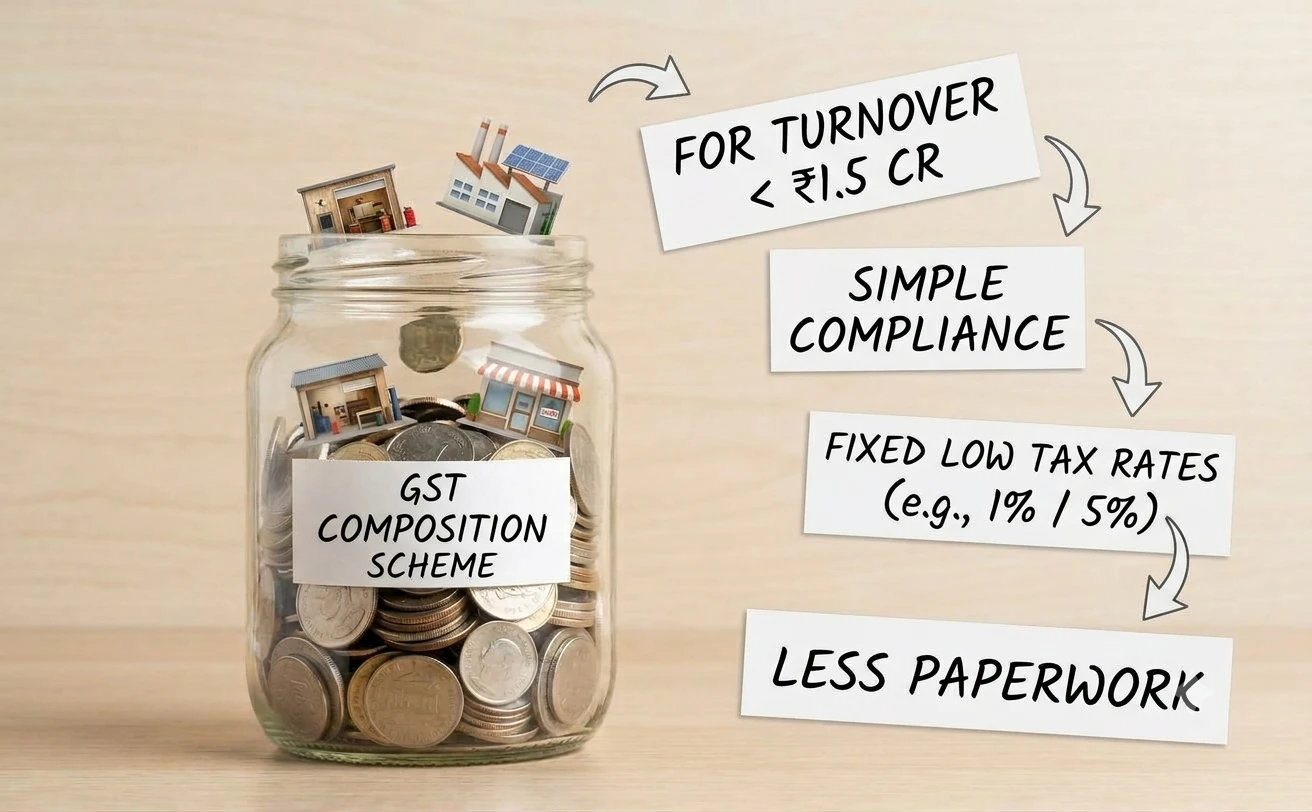
GST Composition scheme is a simplified GST framework for small businesses, for whom the GST compliance can seem intimidating or too difficult to follow. In this scheme, small businesses can pay a fixed percentage of their annual turnover, without claiming Input Tax Credit (ITC). Compliance is shorter, so the small business can focus on becoming successful and avoid the hassle of compliance.
While the GST composition scheme eases compliances, it isn't automatically right for every business. MSMEs who opt in for the GST composition scheme become composition dealers. A composition dealer cannot charge GST separately to their customers and also cannot take input tax credit. Confused? Well, this article explains the GST composition scheme turnover limit, the composition scheme rate, return filing rules, benefits, restrictions, and situations where a business may have to switch to regular GST.
What is the GST Composition Scheme?
The GST composition scheme is a simple Goods and Services Tax (GST) payment mechanism introduced under the CGST Act, 2017. This scheme is available to small taxpayers who pay GST at a prescribed rate of turnover. It is intended for businesses who primarily sell in their state and want easier compliance.
The composition dealer cannot collect GST separately from the buyer. They pay the tax from their own funds against a bill of supply instead of a tax invoice.
The scheme reduces paperwork but also removes some important benefits of regular GST. Therefore, the decision should be based on turnover, the type of customer, profit margins, purchase costs and the need to sell across state borders.
Composition Scheme Turnover Limit Under GST
For most eligible suppliers of goods, the key limit is the aggregate turnover of ₹1.5 crore. In simple terms, the scheme may generally be considered by a business, if its PAN-based aggregate turnover in the preceding financial year does not exceed ₹1.5 crore (subject to the applicable conditions and state-specific rules).
For some special category states, the applicable limit is up to ₹75 lakh. Businesses should check the GST composition scheme limit for their state before opting in. The term ‘aggregate turnover’ gains significance as it is computed on an all-India basis under the same PAN. It may include taxable supplies, exempt supplies and exports and inter-state supplies, normally excluding GST and certain inward supplies that are taxable under reverse charge.
As per the Section 10 (2A) of the CGST Act, eligible service providers and mixed providers/suppliers with an annual turnover of up to ₹50 Lakhs for the last financial year, can pay GST at a prescribed rate, capped at a maximum of 3% The eligibility conditions and rate are different from the main goods-focused scheme.
The threshold is not a licence to ignore the GST registration rules. The business still has to fulfil the conditions of the relevant composition option, and comply with the registration and invoicing requirements.
Planning for the year you cross Rs 1.5 crore? A one-minute eligibility check tells you how much loan business can raise against your property.
GST Composition Scheme Rates: How Much Is Payable?
We saw in the section above that the total GST composition scheme limit is ₹1.5 Cr. for traders, retailers, and manufacturers. For special states, the limit goes down to ₹75 Lakhs. And, up to ₹50 Lakhs annual turnover for eligible service providers and mixed providers/suppliers under Section 10(12A) of CGST Act.
Aggregate turnover means all supplies under one PAN, across all businesses, nation-wide. So, all GSTINs under one PAN will be included in this aggregate turnover. Check the Composition scheme turnover limits in the table below:
| Business type | Turnover limit (2026) | Applies to |
|---|---|---|
| Traders, retailers, manufacturers | ₹1.5 crore | Most states |
| Traders, retailers, manufacturers | ₹75 lakh | Arunachal Pradesh, Manipur, Meghalaya, Mizoram, Nagaland, Sikkim, Tripura, Uttarakhand |
| Restaurants (no alcohol) | ₹1.5 crore | Most states |
| Service providers (Under Section 10(2A)) | ₹50 lakh | All states |
These rates are applied subject to the relevant notifications and conditions, and taxpayers should check the current position before filing.
Composition Scheme Tax Rates
The tax rates for composition schemes are flat percentage rates on turnover, divided equally between State and Central GST. There are 4 rates to refer in 2026:
| Business type | Total rate | Split (CGST + SGST) |
|---|---|---|
| Traders and retailers | 1% | 0.5% + 0.5% |
| Manufacturers | 1% | 0.5% + 0.5% |
| Restaurants (not serving alcohol) | 5% | 2.5% + 2.5% |
| Service providers (₹50 lakh scheme) | 6% | 3% + 3% |
You can check the example below for better understanding.
- Annual Turnover: ₹40 Lakhs
- Total Rate: For eligible traders, the GST composition scheme rate is 1% of turnover
- Total tax to be paid: 40,00,000*1% = ₹40,000
- Tax split: The tax percentage is split between SGST and CGST.
- CGST of 0.5%
- SGST of 0.5%
- Split tax calculation:
- CGST payable: ₹40,00,000 * 0.5% = ₹20,000
- SGST payable: ₹40,00,000 * 0.5% = ₹20,000
Who is Not Eligible for the GST Composition Scheme?
The GST composition scheme is a good deal for small businesses. However, as per the scheme, there are some businesses who cannot take advantage of this composition scheme.
First of all, if you are any business with turnover more than the predefined threshold annual turnover, you are automatically not eligible in the GST Composition scheme. Beyond that, the following table represents the information with sections under which they are ineligible for the composition scheme. Please take a look.
| Ineligible Category | Detailed Description / Constraint | Statutory Reference |
|---|---|---|
| Inter-State Outward Suppliers | Taxpayers making any outward supply of goods or services outside their registered state or union territory. (Note: Inter-state purchases are fully permitted). | Section 10(2)(b) & Section 10(2A)(b) of the CGST Act |
| ECO Service Suppliers | Businesses supplying services through an Electronic Commerce Operator (ECO) required to collect TCS. (Intra-state supply of goods through ECOs is permitted). | Section 10(2)(d) & Section 10(2A)(c) of the CGST Act |
| Manufacturers of Notified Goods | Manufacturers of restricted items including: ice cream, pan masala, tobacco products, aerated water, fly ash bricks/blocks, earthen/roofing tiles, and building bricks. | Section 10(2)(e) of the CGST Act / Notification No. 14/2019-CT |
| Non-Taxable Goods/Services Suppliers | Persons engaged in supplying items not leviable to GST (e.g., alcohol for human consumption, specified petroleum products). | Section 10(2)(a) & Section 10(2A)(a) of the CGST Act |
| Casual Taxable Persons (CTP) | Individuals who occasionally supply goods/services in a state/UT where they have no fixed place of business. | Rule 5(1)(a) of CGST Rules, 2017 / Section 10(2A)(e) of the CGST Act |
| Non-Resident Taxable Persons (NRTP) | Any person who occasionally supplies goods or services but has no fixed place of business or residence in India. | Rule 5(1)(a) of CGST Rules, 2017 / Section 10(2A)(e) of the CGST Act |
You can check the details on: https://taxinformation.cbic.gov.in/
A business that wants to sell to customers outside of its state should consider the effect carefully. A composition dealer can buy goods from outside the state, but conditions and restrictions on outward supplies must be examined before entering into such transactions.
What is a Bill of Supply?
A composition dealer cannot issue a normal GST tax invoice as the dealer is not able to collect GST from the customer. The dealer issues a bill of supply in lieu of a tax invoice. The document shall contain the necessary details and clearly state that the supplier is paying tax under the composition scheme and is not required to collect tax from the recipient.
This is important to both the seller and the purchaser. Customers should not consider a bill of supply as a document for availing input tax credit. If a composition dealer collects GST incorrectly, they may have tax and penalty exposure.
Advantages and Disadvantages of GST Composition Scheme
Check out the advantages and disadvantages of the composition scheme mentioned below:
Advantages of Composition Scheme
- Reduced compliance: Businesses fill only one quarterly return (CMP-08) as compared to monthly and quarterly return (GSTR 3B, GSTR 1) filing in regular GST scheme.
- Reduced Tax burden: Taxpayers are liable to pay only a prescribed rate ranging from 1% to 6% depending on the business type, as opposed to standard GST rate percentages (5%, 8%, 12% etc.).
- Better cashflow management: Lower tax burden, leads to taking home more money in profits, which further help in managing day-to-day finances.
Disadvantages of the GST composition scheme
- No Input Tax Credit (ITC): The biggest trade-off or disadvantage of this scheme is they cannot claim any ITC on their own business purchases or raw materials.
- No tax from customers: Businesses cannot collect any tax from the customer, under the composition scheme
Understanding CMP-08
The GST Composition Levy scheme does reduce a big deal of compliance related matters, it does not make it completely go-away. You have to fill a form called CMP-08 every quarter. It is also called Composition Form 08 and legally titled as, “Statement for payment of self-assessed tax.” It is a statement-cum-challan used by small taxpayers to pay their self-assessed tax liability.
Check quarterly deadlines to file CMP-08:
| Quarter | Coverage Period | Filing Due Date |
|---|---|---|
| Q1 | April 1 to June 30 | Jul-18 |
| Q2 | July 1 to September 30 | Oct-18 |
| Q3 | October 1 to December 31 | Jan-18 |
| Q4 | January 1 to March 31 | Apr-18 |
In addition to this, you also file GSTR 4 at the end of the financial year, which summarizes the year's turnover and tax paid.
Returns and Payment: CMP-08 and GSTR-4
The compliance process is easier than regular GST, but it is not zero-compliance. A composition taxpayer usually follows this cycle: pay self-assessed tax through the CMP-08 return every quarter as the quarterly GST return, then file the annual GSTR-4 return summarising the year's turnover and tax paid.
Moving to regular GST usually means bigger stock cycles and longer credit to B2B buyers. Compare the types of business loans in India to see which one fits that shift.
Summary
For a small trader or local business, the GST composition scheme can be a sensible option if they are looking for easier GST compliance. The main benefits are a flat-rate scheme and less detailed filings. The main costs are the inability to recover input tax credit, the inability to collect GST and restrictions on the type and location of supplies. If you are registered under the GST Composition scheme, you should keep an eye on your annual turnover to avoid any hassles in the middle of the year to switch to the regular scheme.
Frequently Asked Questions
What is the maximum turnover limit of the GST composition scheme for traders?
For most of the eligible traders, the limit normally applicable is an aggregate turnover of ₹1.5 crore in the preceding financial year. There may be a lower limit in certain special category states. The calculation is on the aggregate turnover under one PAN and not just the sales of one shop.
Is input tax credit available to a composition dealer?
No. A composition dealer is not entitled to claim input tax credit on purchases for business. Usually, the GST paid to suppliers is included in the cost of the business.
Is the composition dealer liable to issue a tax invoice?
No. The dealer usually issues a bill of supply and does not charge GST separately to the customer.
Is CMP-08 filed on a quarterly basis for GST return?
Yes, the CMP-08 return is a quarterly GST return of self-assessed tax for a composition taxpayer. It is generally filed by the 18th of the month following each quarter, with extensions. The annual return is filed separately in GSTR-4.
When should a business choose regular GST?
Businesses should think about a switch to regular GST when they exceed the composition limit, start restricted or inter-State outward supplies, wish to claim input tax credit, or sell mainly to GST-registered customers who want credit. Before you make the change, check the effective date and compliance steps.
| Recent Posts |
|---|
Section 44AD Presumptive Taxation: Tax Rules & Filing |
MSME and Government Loan Schemes in India: A Business Owner's Guide |
Loan Against Property Eligibility: LTV, Age & Criteria |
Documents Required for a Loan Against Property |
Union Budget 2025: Key Reforms and Opportunities for MSMEs |
Used Car Loans: Meaning, Eligibility Criteria |
Unsecured Business Loan - All You Need To Know |
Business Loan Eligibility and Required Documents |
Top 5 Reasons to Get a Business Loan in India |
Collateral-Free Loans in India: How to Apply |
Types Business loan in india |
Unsecured Finance: Types, Definition, and How It Works |
How to choose the right business loan in india |
How to improve credit score importance ranges tips |
Business loan interest rates flat vs reducing |
| Secured Business Loan |
|---|
Loan Against Property Eligibility and LTV |
Documents Required for Loan Against Property |
Secured Business Loan in India |
Types of Secured Business Loan |
How to apply for Secured Business loan |
Eligibility Criteria for Secured Business Loan |
Document Required for Secured Business loan |
| Unsecured Business Loan |
|---|
Unsecured Business Loan - All You Need To Know |
Collateral-Free Loans in India |
Unsecured Business Loan in India |
Types of Unsecured Business Loan |
How to apply for Unsecured Business loan |
Eligibility Criteria for Unsecured Business Loan |
Document Required for Unecured Business loan |
Stay up-to-date with our
Newsletter