GST 2.0 Reforms: Everything You Need to Know
06 September 2025
India's indirect taxation undergoes a structural change with the introduction of the new GST 2.0 reform, also known as the Next Generation GST Reform. The GST Reform Bill (popularly called GST 2.0), cleared by the GST Council, will roll out from 22nd September, 2025, just ahead of the festive season.
The reforms include a more simplified tax structure with only two slabs to increase consumption among the middle class. Businesses will spend less time solving compliance complications and focus more on business growth and expansion.
In this article, we will speak about the critical GST reforms, the problems that the GST 2.0 reforms form, and key rate cuts.
Key Takeaways
- Simplified Tax Structure: GST 2.0 introduces a simplified two-slab structure (5% and 18%) replacing the previous four-slab system, making taxation easier to understand and comply with.
- Economic Growth Boost: The new structure aims to increase consumption among the middle class by reducing tax burden on essential goods and services, stimulating economic growth.
- Business-Friendly Reforms: Reduced compliance complexity allows businesses to focus more on growth and expansion rather than tax management, improving ease of doing business.
- Sin Goods Taxation: A new 40% tax slab is introduced for sin goods and luxury items to offset revenue losses while discouraging consumption of harmful products.
- Global Competitiveness: The simplified structure brings India closer to international best practices, making Indian goods more price-competitive in global markets.
GST 2.0 Benefits at a Glance
The upcoming GST 2.0 reforms bring a simpler and fairer tax system for both consumers and businesses. Essentials get cheaper, compliance is easier, and luxury/sin goods are kept under higher tax to balance the economy.
To better understand how these changes impact you, let's have a look at the GST 2.0 rate slabs and their benefits.
0% GST Slab
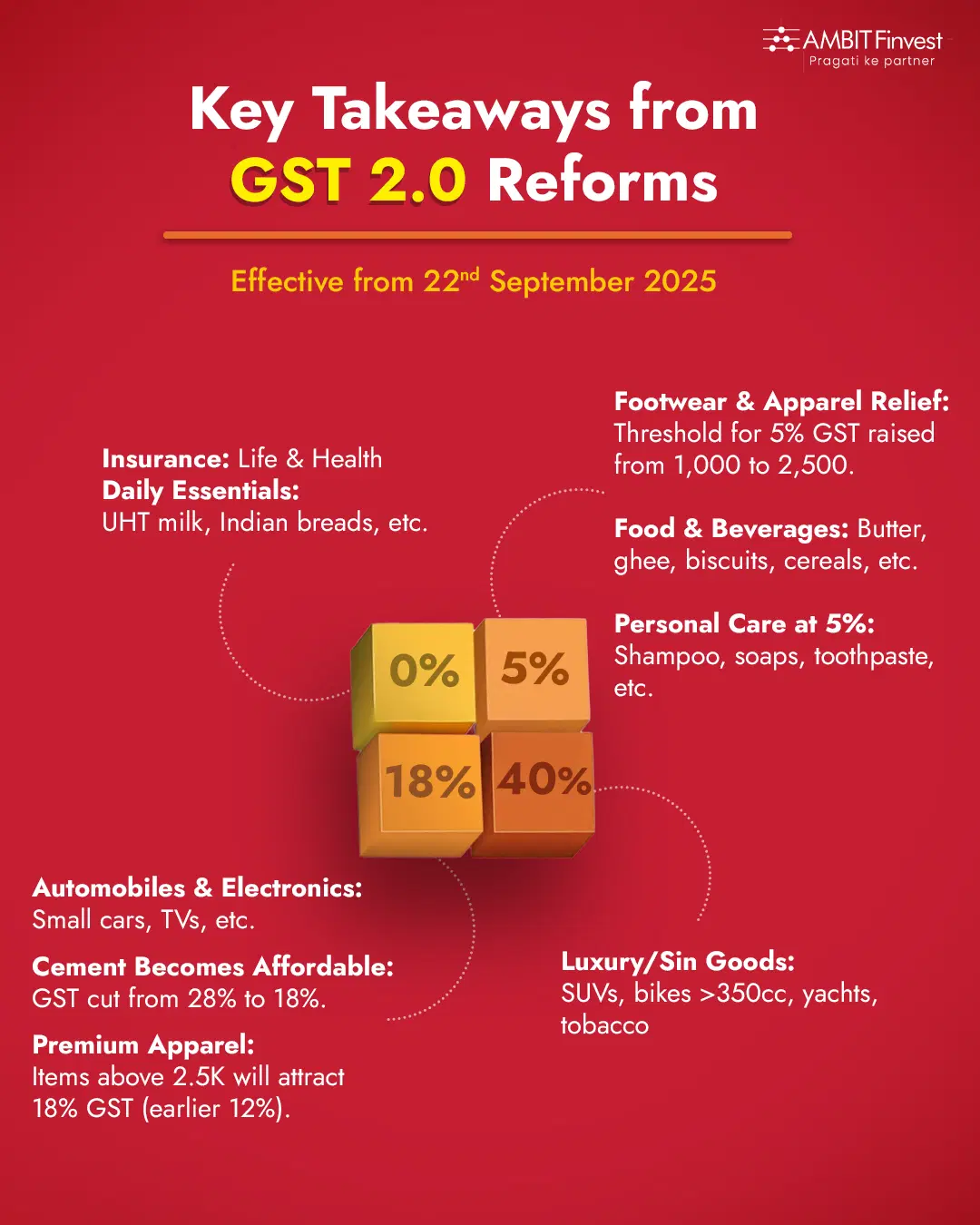
Items like life & health insurance, UHT milk, Indian breads, and other daily essentials are kept completely tax-free. This helps families save more on routine expenses and ensures wider access to health protection.
5% GST Slab
Products such as shampoos, soaps, toothpaste, footwear up to ₹2,500, butter, ghee, cereals, and biscuits now fall under 5%. This makes common household and personal care items cheaper, directly benefiting middle-class households.
18% GST Slab
The standard 18% rate covers small cars, two-wheelers under 350cc, TVs, cement, premium apparel above ₹2,500, electronics, and services like restaurants and telecom. By reducing cement and automobile GST (from 28% to 18%), the government boosts affordability in the construction and mobility sectors.
40% GST Slab
High-end goods like SUVs, luxury bikes above 350cc, yachts, and tobacco products are taxed at 40%. This discourages excessive consumption of harmful products while ensuring higher revenue contribution from luxury segments.
Understanding the Next Generation GST Reform
The GST 2.0 reform is all about ease of living for citizens and ease of doing business for all. The 56th meeting of the GST Council held on 3rd September, 2025, paved the way for a broad two slab GST structure.
The GST tax structure launched 8 years back had four slabs: 5%, 12%, 18% and 28%. It is now revised to 2 slabs: 5% and 18%. A merit rate of 5% and a standard rate of 18%. A demerit rate of 40% applies to super luxury, sin and demerit goods including tobacco and cigarettes.
Did you know?
Sin goods are products that are considered harmful to society or individual health. In the case of GST 2.0, these products are pan masala, tobacco, cigarettes, coal, etc.
The new structure will take effect from 22nd September, 2025. It will make taxation easier, leave more money in the hands of the commoner, and help businesses streamline their tax processes. Here are the highlights of the GST 2.0 reforms.
Benefits of GST 2.0 Reform
GST Rationalization is a step taken by the Government to reduce the tax burden on the common man. The aim is to keep more money in the hands of the middle class and increase consumption that was declining over the last few quarters.
Now, let's understand in detail the need for GST 2.0 Reform.
Consumption Boost & Economic Growth
One of the major concerns for the Government was decreasing consumption among the Indians. To boost this, the government introduced changes in the GST slab structure. The reduction in slab structure across various categories including, insurance, education, medical, and automobile, the government wants the middle class of the nation to have more disposable income.
Let's understand how this will happen:
Increased affordability
With the new GST structure, the government has tried to give back to the larger, tax-paying class of the society. The two-slab structure will give a chance for the "aam aadmi" to save more while increasing consumption.
From small cars to packaged foods and personal care, everything is going to get a price cut, literally, everything.
To offset any expected revenue losses, an extra slab introduced a 40% tax on sin goods or demerit goods such as cigarettes, tobacco etc.
Revived demand
Sectors, especially FMCG and automobiles, which saw a fall in demand over the last few quarters will now see a revived demand. If you are planning to buy a new car or a bike, do check out the tax revisions, before buying one. The new GST slabs have been reduced to 18% for motor cycles, Cars and other motor vehicles for goods.
Multiplier effect
With affordability, the market creates a demand due to increased consumption. This will lead to increased production and further strengthening GDP, and increasing employment.
Tax Structure Simplified
GST tax structure is now simplified. The original structure had multiple slabs, namely, 5%, 12%, 18%, 28%, with a complex cess structure.
With the new structure, the GST regime is more straightforward, easier to understand, and reduced complexity for businesses. To understand it better, go through the following pointers:
Introducing a two-slab structure
The next Generation GST reforms come with only 2 tax slabs, the 5% and 18%. There will be an additional 40% slab which is introduced on sin products or demerit products. Sin goods or demerit products are the ones that cause health damage, like tobacco.
It will help consumers understand the tax on goods and services, leading to better transparency. It will also eliminate the invoicing complications, resolve classification disputes, and make compliance easier. It will lower costs for the businesses, which can then be passed on to the consumers.
Correcting Inverted Duty Structure
Before we dive into how the inverted duty structure is corrected, let's understand what is inverted duty structure.
Inverted duty structure is a tax structure where the finished products attract lesser tax as compared to the input materials/raw materials. The ink used for printing the books attracts less tax than the books themselves. This is also true for the clothing industry, where the clothing manufacturer pays more tax on fabric but less on the finished product.
Due to higher input taxes, manufacturers faced working capital stress. Also, the wait to claim these back was a challenge. This challenge will now be solved as the GST council has allowed provisional refunds on these requests.
Long-Term Potential Impact
There are some long-term potential impacts of the new GST slabs that are being introduced and are about to go-live on 22nd September, 2025. Let's understand them in detail:
India's Economic Landscape
The simplified tax structure is not just about reducing goods prices; it encompasses much more than that. This structural reform will encourage more businesses to formalize, as compliance is easier to predict.
Input costs will be reduced and tax-related distortions will be eliminated, boosting manufacturing competitiveness. The reduced tax burden on essential items will leave more disposable income in the hands of the middle class and low-income households, reducing income inequality.
Small and medium enterprises can now focus on core business activities rather than tax management due to lower compliance costs and improved cash flows.
Competing on a global scale
India, with the new GST structure, comes closer to international best practices in terms of indirect taxation. Countries like Australia have a single 10% GST rate, while Canada operates at 5% federal GST with provincial additions.
The two-slab system, introduced with next-generation GST reforms aims to increase consumption and leave more money in the hands of the middle class and the neo-middle class. It will also reduce the cost of doing business, making Indian goods more price-competitive in international markets.
Wrapping Things Up
Next-Generation GST Reforms, or GST 2.0, is a structural reform in the GST tax structure since its launch in 2017. The new GST structure resolves the major criticism faced by it, the complexity.
Consumers are likely to benefit from the move, as evidenced by the tax structure and changes shared by the PIB. The 0% GST on individual health and life insurance will surely help penetration grow in every sector of the society.
Micro, Small, and Medium Enterprises (MSMEs) will be able to focus on core business activities with fewer tax complications to worry about and fewer compliance issues. Over and over, the GST 2.0 reform was a much needed relief for both consumers and MSME owners.
Frequently Asked Questions
What is the new GST rate list in 2025?
The new GST rate structure has mainly three slabs: 0% (exempt), 5% (merit goods), 18% (standard goods) and a special 40% slab for sin and luxury goods like tobacco and high-end cars. The previous 12% and 28% slabs are removed to simplify taxation.
Which goods had 12% GST before, and what about 2025?
Previously, processed foods, fruit juices, butter, ghee, and some other items were taxed at 12%. From 2025, the 12% slab is abolished—these items mostly move to either 5% or 18% GST slabs depending on the category.
Which items come under the 18% GST slab in 2025?
The 18% slab includes most standard goods and services such as:
• Motor vehicles (cars below 1200cc petrol, 1500cc diesel), two-wheelers under 350cc
• Electronics like TVs, refrigerators, washing machines
• Restaurant and financial services
• Consumer durables and daily use appliances.
Which items have 18% GST as per the 2025 reforms?
Items such as standard motor vehicles (smaller cars, bikes), electronics (TVs, appliances), restaurant services, telecom, and many consumer goods fall under the 18% slab.
On which products is the GST rate reduced in 2025?
GST rates are reduced on several items including:
• Small cars
• Motorcycles under 350cc
• Packaged foods, shampoos, soaps, medicines, footwear (below value threshold)
• Air conditioners, televisions, washing machines
What is the new GST rule for cars in 2025?
Cars below defined thresholds (petrol ≤1200cc, diesel ≤1500cc, length ≤4000mm) are now taxed at 18% GST, down from 28% plus cess. Larger and luxury cars have a flat 40% GST, replacing the previous 28% + cess structure, resulting in overall lower tax burden.
Are cars expected to get cheaper in 2025 due to GST reforms?
Yes, many small and mid-sized cars will be cheaper as the combined GST and cess tax rates are reduced under the new slab system. The removal of compensation cess also lowers prices despite the new 40% slab on big luxury cars.
| Recent Posts |
|---|
GST 2.0 Reforms: Everything You Need to Know |
Union Budget 2025: Key Reforms and Opportunities for MSMEs |
GST Registration Process and Benefits in India |
Top 10 Tax-Saving Tips for Entrepreneurs |
UDYAM Registration: A Simple Guide for MSMEs |
Top 5 Union Budget 2024 Highlights for MSMEs |
How to Get Your First Business Loan in India |
8 Essential Types of Business Loans in India |
Unsecured Business Loan - All You Need To Know |
Business Loan Interest Rates: Flat vs Reducing |
How to Choose the Right Business Loan |
CIBIL Score: 5 Essential Tips to Boost Your Credit |
Collateral-Free Loans in India: How to Apply |
Used Car Loans: Meaning, Eligibility Criteria |
7 Proven Strategies for MSME Cash Flow Management |
| GST & Tax Related |
|---|
GST 2.0 Reforms: Everything You Need to Know |
Union Budget 2025: Key Reforms and Opportunities for MSMEs |
GST Registration Process and Benefits in India |
Top 10 Tax-Saving Tips for Entrepreneurs |
UDYAM Registration: A Simple Guide for MSMEs |
Top 5 Union Budget 2024 Highlights for MSMEs |
| Business Loans |
|---|
How to Get Your First Business Loan in India |
8 Essential Types of Business Loans in India |
Unsecured Business Loan - All You Need To Know |
Business Loan Interest Rates: Flat vs Reducing |
How to Choose the Right Business Loan |
CIBIL Score: 5 Essential Tips to Boost Your Credit |
Stay up-to-date with our
Newsletter