CGTMSE Scheme Explained: Collateral-Free MSME Loans Up to ₹10 Crore
6 October 2026
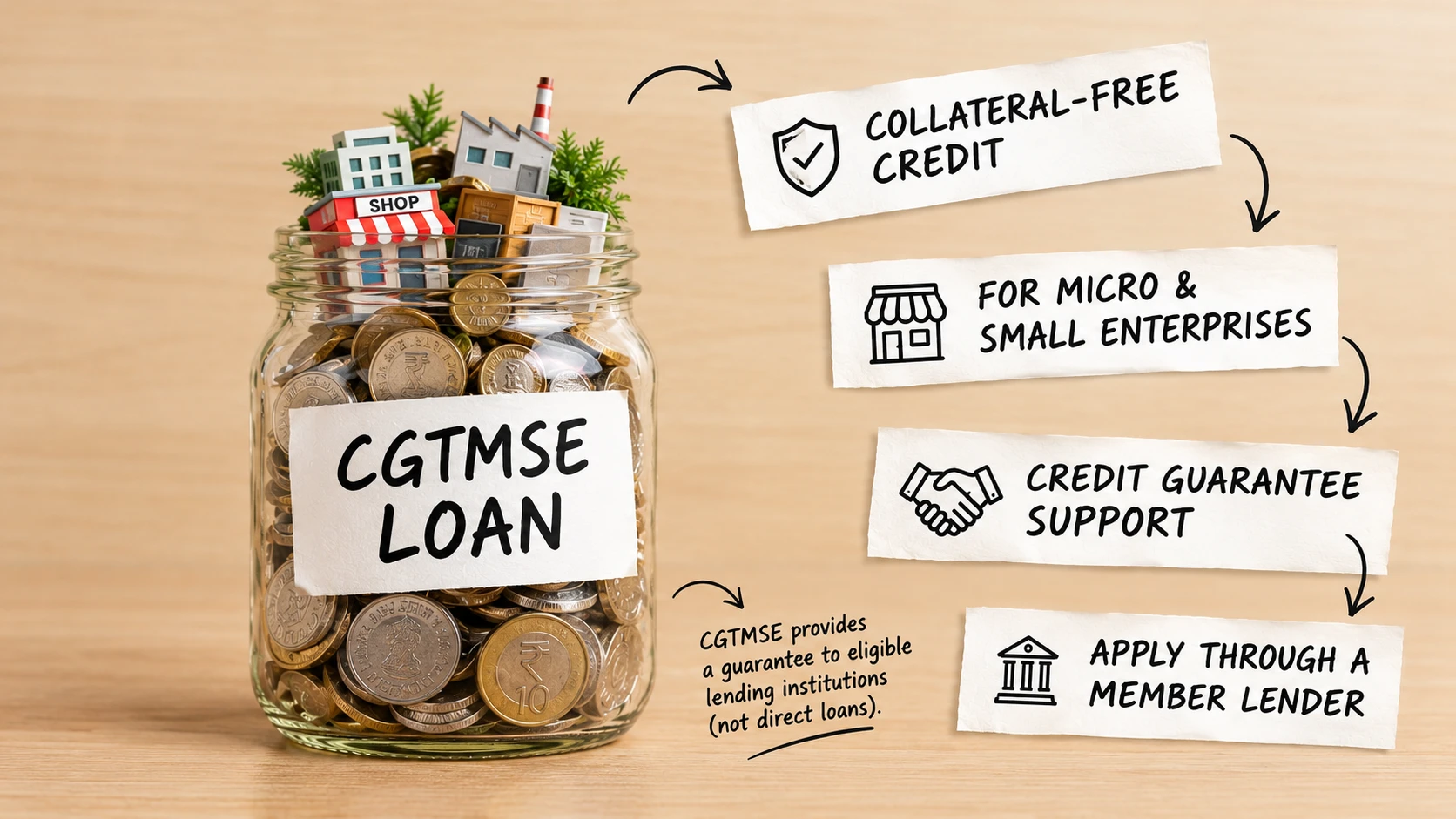
CGTMSE scheme is a government scheme designed to promote entrepreneurship by providing the financial safety net to the lenders, rather than directly providing finance to businesses.
Many small businesses in India find it difficult to get a loan from a bank, as they need property or another asset to offer as collateral. Under the Credit Guarantee Fund Trust for Micro and Small Enterprises (CGTMSE) Scheme, eligible Micro and Small Enterprises are able to obtain credit without the need for collateral or a third-party guarantee.
Over the years, CGTMSE scheme has encouraged entrepreneurship and become a powerful enabler of growth and financial inclusion in the MSME ecosystem.
In this article, we cover the CGTMSE scheme details, eligibility, guarantee cover, fees, Udyam registration, the step-by-step application process, possible uses of the funds and the key points MSMEs should check before applying.
What is the CGTMSE Scheme?
CGTMSE scheme is a joint initiative established by the Ministry of Micro, Small and Medium Enterprises and SIDBI in 2000. The scheme encourages banks and other NBFCs to support small businesses by providing a credit guarantee of 75-80% of the loan amount.
CGTMSE is a collateral-free loan, but the terms differ from your actual collateral-free loans. In simple terms, the lender gets 75-80% credit guarantee of every loan they disburse from the Trust (CGTMSE). Therefore, the lender does not ask you for a collateral. We will talk about this in detail, in the upcoming section.
If you are applying to the CGTMSE scheme, remember that you will not apply to the Trust, you apply in a bank. The application is made to a bank, financial institution, or other approved Member Lending Institution (MLI). The MLI, after sanctioning/processing the eligible credit facility, sends the guarantee request to CGTMSE. MLI are entities that are directly partnering with or registered with CGTMSE to provide collateral-free loans to the MSMEs.
How does CGTMSE scheme work?
CGTMSE scheme is a good tool for lenders and borrowers to encourage entrepreneurship in people. While the process seems really simple for an application, there are multiple moving parts to this application. Let's take a look at it.
Apply at an MLI
An MLI can be a bank, NBFC or any other financial institution that has partnered or registered with CGTMSE to provide collateral-free loans. So basically, your application will be raised to one of these institutes, not directly to the Trust or Government.
Application Evaluation
The bank will evaluate your application like they would for any other application. Check your business plan and repayment facility. They would also ask you for collateral, however, if you do not have a collateral to pledge, the bank will request credit guarantee on the CGTMSE portal. Borrowers cannot reach out to the Trust directly.
Guarantee Coverage
CGTMSE then studies the request, checks for the loan amount and approves the guarantee cover for the bank. Typically, this guarantee cover is 75-80% of the total loan amount. It protects the lender against any repayment defaults by the borrower like a guarantor.
Guarantee Fees
For activating the cover, the banks need to pay an Annual Guarantee Fee (AGF) ranging from 0.37% to 1.35% (Plus GST) depending on the loan size. While the bank is supposed to pay this amount, the amount is often added to the borrower's expenses. Check out the detailed breakup of the fees, as disclosed by the CGTMSE website as of April 1, 2025.
| Slab | Standard Rate (pa)* |
|---|---|
| 0-10 lakh | 0.37 |
| Above 10 lakh - 50 lakh | 0.55 |
| Above 50 lakh - 1 crore | 0.60 |
| Above 1 crore - 2 crore | 0.85 |
| Above 2 crore - 5 crore | 1.00 |
| Above 5 crore - 8 crore | 1.10 |
| Above 8 crore - 10 crore | 1.20 |
Details of CGTMSE Scheme: Loan Limit and Facilities Covered
The scheme at present covers fund-based and non-fund-based facilities up to ₹10 crore per eligible borrower. These may include term loans, cash credit, letters of credit and bank guarantees subject to the conditions of the scheme. Or, separate coverage can be provided for a term loan or working capital facility.
| Facility Type | Examples | Nature of Cover |
|---|---|---|
| Fund-based | Term loans, cash credit/working capital limits | Direct credit extended to the borrower |
| Non-fund-based | Letters of credit, bank guarantees | Contingent credit facilities extended on the borrower's behalf |
| Hybrid security | A mix of collateral-backed and CGTMSE-covered portions | Collateral taken for part of the facility; the remaining eligible part is covered by CGTMSE, up to ₹10 crore |
If a lender sanctions more than ₹10 crore, the CGTMSE guarantee cover remains limited to the permitted limit. The hybrid security product allows collateral to be taken against one part, and the remaining eligible part is covered.
Who Can and Cannot Avail a CGTMSE Loan?
Generally, new and existing Micro and Small Enterprises engaged in manufacturing/service activities may be considered.
As per the official CGTMSE website, activities in the service sector under the MSMED framework are eligible, while agriculture, self-help groups and joint liability groups are excluded under the relevant scheme. Small loans for road and water transport could also be eligible.
The applicant should be compliant with the credit policy of the lender and the scheme conditions of CGTMSE. A business should generally have:
- Valid business structure and PAN.
- Valid Udyam Registration Number.
- A clear purpose for the loan.
- Bank statements and financial records.
- Evidence of sales, orders or operating activity where applicable.
- A repayment schedule based on realistic cash flows.
Udyam registration is essential. Every new CGTMSE application needs the borrower's Udyam Registration Number, so get this done before you approach a lender.
Need funds while your CGTMSE paperwork is still with the lender? Ambit Finvest's secured business loan can fund up to ₹3 crores without collateral or a guarantee-scheme queue.
What Does a Collateral-Free in CGTMSE for MSME Mean?
A collateral-free loan for MSMEs means the lender does not require any collateral for the loan given to the borrower. In CGTMSE, there is a slight difference. As per the official documentation:
- No External Collateral: The scheme does not require traditional collateral like commercial or residential property or a third party guarantor.
- Primary assets: Your primary assets like machines or equipment purchased through loan funds are directly mortgaged by the lender.
- Repayment obligation: The guarantee covers the bank's losses, not the borrower's debt. The bank will have the right to seize your primary collateral, if borrowers default payments.
Other lending conditions, such as documentation, insurance and promoter contribution, may also apply. Eligibility and security requirements can vary based on the lender and the type of facility.
Coverage: How Much Risk is Covered?
Guarantee coverage is the portion of an eligible MSME loan that CGTMSE may cover for the Member Lending Institution (MLI), such as a bank or financial institution, if the borrower defaults. It reduces the lender's risk but does not reduce the borrower's outstanding loan or mean loan forgiveness.
Current CGTMSE Guarantee Coverage Matrix (Up to ₹10 Crore)
| Borrower / Category | Loan Slab | Official Guarantee Cover |
|---|---|---|
| Micro Enterprises | Up to ₹5 Lakh | 85% |
| Micro Enterprises | Above ₹5 Lakh to ₹10 Crore | 75% |
| Women Entrepreneurs & Agniveers | Up to ₹10 Crore | 90% |
| SC/ST / PwD / ZED Certified / Aspirational Districts | Up to ₹10 Crore | 85% |
| MSEs in NER (incl. J&K, Ladakh) | Up to ₹50 Lakh | 80% |
| MSEs in NER (incl. J&K, Ladakh) | Above ₹50 Lakh to ₹10 Crore | 75% |
| General MSME Borrowers | Up to ₹10 Crore | 75% |
For eligible defaults, CGTMSE may pay the lender a specified percentage of the guaranteed amount, subject to the applicable coverage limit. In standard cases, this can be 75%, with higher limits of 80%, 85% or 90% applying in specified cases. The lender remains responsible for recovering the outstanding loan.
The guarantee claim does not necessarily coincide with the outstanding loan. The lender has to follow the claim process, coverage percent, caps, lock-in period and other conditions.
How to Apply for a CGTMSE Loan
You do not apply to CGTMSE directly. The application goes through a lender, and the lender requests the guarantee cover. Here's how the process works:
- Step 1: Get Udyam registration: Register your business on the Udyam portal and keep your Udyam Registration Number ready.
- Step 2: Choose a Member Lending Institution (MLI): Approach a bank, NBFC or financial institution that offers CGTMSE-backed loans.
- Step 3: Prepare your loan proposal: Include your business history, promoter details, loan purpose, sales and cash-flow projections, and repayment plan.
- Step 4: Submit your documents: These typically include Udyam Registration, PAN, identity proof, tax documents, bank statements, financial statements, licences, machinery quotations and existing loan details.
- Step 5: Lender assessment: The lender reviews your business viability, credit history and repayment capacity before sanctioning the loan.
- Step 6: Guarantee cover: Once the loan is sanctioned, the lender applies to CGTMSE for guarantee cover.
- Step 7: Review the terms before signing: Check the sanctioned amount, interest rate, tenure, moratorium, security, AGF, repayment schedule and renewal terms.
Finding it difficult to secure funds through government schemes? Compare the types of business loans in India to see how a secured loan against property can fit your requirement.
Uses of CGTMSE-Backed Funds
CGTMSE-backed credit can support several business needs, depending on the facility approved by the lender. Common uses include:
- Inventory purchase: Buying raw materials, stock or other goods required for regular business operations.
- Supplier payments: Meeting payments to vendors when customer collections are received later.
- Wages and salaries: Managing employee payments during periods of uneven cash flow.
- Rent and utilities: Covering regular operating expenses such as office or shop rent, electricity and other bills.
- Receivables cycle: Bridging the gap between supplying goods or services and receiving payment from customers.
- Business expansion: Funding eligible business-related requirements where the lender permits the use under the approved credit facility.
- Machinery and equipment: Term credit backed by the guarantee can be used for eligible business assets, subject to the lender's terms.
Conclusion
The CGTMSE Scheme is able to provide formal finance to eligible MSMEs which do not have adequate collateral. It can assist with expansion, purchase of equipment, and working capital needs, with coverage of eligible facilities up to ₹10 crore. The approval, however, depends on other factors like viability of the business, repayment capacity, documentation, lender policy and compliance with CGTMSE rules.
Before applying for a CGTMSE loan, get Udyam registration done, keep accurate financial records ready, compare MLI offers, and understand the guarantee cover and annual guarantee fee. If you're unable to secure funding through government schemes you can consider the tailored lending solutions offered by Ambit Finvest.
Frequently Asked Questions
| Recent Posts |
|---|
Business Loans for Women Entrepreneurs in India: Schemes and Options |
How to Improve Your CIBIL Score to Get a Business Loan |
Section 44AD Presumptive Taxation: Tax Rules & Filing |
MSME and Government Loan Schemes in India: A Business Owner's Guide |
Loan Against Property Eligibility: LTV, Age & Criteria |
Documents Required for a Loan Against Property |
Union Budget 2025: Key Reforms and Opportunities for MSMEs |
Used Car Loans: Meaning, Eligibility Criteria |
Unsecured Business Loan - All You Need To Know |
Business Loan Eligibility and Required Documents |
Top 5 Reasons to Get a Business Loan in India |
Collateral-Free Loans in India: How to Apply |
Types Business loan in india |
Unsecured Finance: Types, Definition, and How It Works |
How to choose the right business loan in india |
How to improve credit score importance ranges tips |
Business loan interest rates flat vs reducing |
| Secured Business Loan |
|---|
Loan Against Property Eligibility and LTV |
Documents Required for Loan Against Property |
Secured Business Loan in India |
Types of Secured Business Loan |
How to apply for Secured Business loan |
Eligibility Criteria for Secured Business Loan |
Document Required for Secured Business loan |
| Unsecured Business Loan |
|---|
Unsecured Business Loan - All You Need To Know |
Collateral-Free Loans in India |
Unsecured Business Loan in India |
Types of Unsecured Business Loan |
How to apply for Unsecured Business loan |
Eligibility Criteria for Unsecured Business Loan |
Document Required for Unecured Business loan |
Stay up-to-date with our
Newsletter